



Study Abroad Content Writer | Updated On - May 18, 2026
The choice between Fall and Spring intake is one of the first decisions every Indian student planning to study abroad must make – and it affects far more than just when you start classes. It directly impacts your course availability, scholarship access, internship eligibility, job market timing, and acceptance rate. Fall intake (August/September) is the primary academic intake across the USA, UK, Canada, and Australia. Spring intake (January) is a secondary option available at select universities. For most Indian students, Fall is the stronger choice – but Spring is not a fallback. It is a deliberate strategic option for specific situations.
- Fall intake gives you more of everything: More programs, more scholarships, more internship windows, and better alignment with campus recruitment cycles. Nearly all top-ranked universities – including those offering MBA and STEM programs – open admissions only in the fall.
- Spring intake has a genuinely higher acceptance rate: Fewer students apply in January, which means less competition for the seats that are available. For students who missed Fall deadlines or need more preparation time, Spring is a real and valid pathway – not a consolation prize.
- The internship gap is the most underestimated Spring disadvantage: In the USA, most summer internships require 9 months of prior study. Spring intake students who start in January typically do not meet this threshold by the first summer. This delays their first internship by a full year compared to Fall intake students.
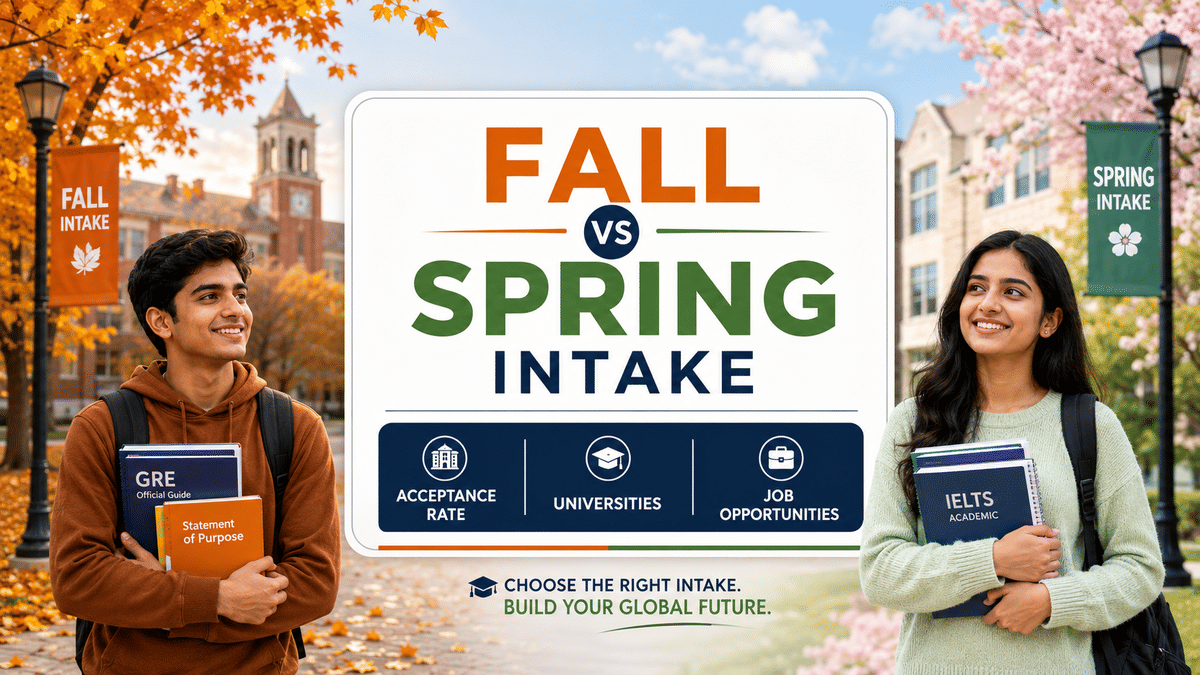
- What are Fall Intake and Spring Intake
- Fall vs Spring Intake: Key Differences
- Acceptance Rate: Is Spring Really Easier to Get Into?
- Course and Program Availability
- Scholarships and Financial Aid: Which Intake Offers More
- Internships and Job Opportunities
- Universities Offering Spring Intake
- Application Deadlines: Fall 2027 and Spring 2027 Timelines
- FAQs
What are Fall Intake and Spring Intake
Fall intake and Spring intake are the two main academic entry points at universities in the USA, UK, Canada, and Australia. They refer to the semester in which you begin your degree program.
- Fall intake begins in August or September, depending on the country and university.
- It is the primary academic intake – the start of the official academic year.
- The majority of programs, scholarships, and campus activities are structured around this intake.
- Spring intake begins in January.
- It is a secondary intake offered by select universities.
- Not all universities offer Spring intake, and not all programs within a university that offers Spring intake are available in January.
| Detail | Fall Intake | Spring Intake |
|---|---|---|
| Start month | August/September | January |
| End month | December | May |
| Type | Primary intake (main academic year) |
Secondary intake |
| Also known as | Autumn intake, September intake | January intake, Winter intake (in some countries) |
| Countries where available | USA, UK, Canada, Australia, Germany, France, Ireland, Netherlands, and most study destinations | USA, Canada, Australia, Ireland (select universities only) |
| Application deadline (typical) | November–March (for the following September) |
August–October (for the following January) |
A common misconception among students on Reddit: "Spring intake is only for students who couldn't get into Fall." This is not accurate. Spring intake is a deliberate choice for working professionals, students who need more preparation time and those who missed Fall deadlines for valid reasons.
Fall vs Spring Intake: Key Differences
The differences between Fall and Spring intake go well beyond the start date. They affect your entire academic and professional trajectory – from which programs you can access to when you can apply for your first internship.
The table below covers every factor that matters to Indian students making this decision.
| Factor | Fall Intake | Spring Intake |
|---|---|---|
| Course availability | Widest range – all programs open in Fall | Limited – many programs not available in January |
| Scholarships | Most scholarships and assistantships are available | Fewer scholarships; most funding allocated at year's start |
| Acceptance rate | More competitive due to higher applicant volume | Higher acceptance rate due to fewer applicants |
| Class size | Larger – more peers, more networking opportunities | Smaller – more individual attention from faculty |
| Summer internship eligibility (USA) | Eligible after the first year (9-month requirement met) |
Not eligible in the first summer (9-month requirement not met) |
| Campus recruitment alignment | Graduates in May – aligns with peak hiring season | Graduates in December – fewer immediate openings |
| Admission decision speed | Slower – high volume of applications | Faster – fewer applications to process |
| Visa processing time | More time available; less peak-season pressure | Tighter timeline; apply for a visa immediately after admission |
| Housing availability | More competitive – large cohort arriving simultaneously | Easier – fewer students arriving in January |
| Extracurricular activities | Most clubs and societies open recruitment in the fall | Fewer clubs recruiting mid-year |
Acceptance Rate: Is Spring Really Easier to Get Into?
Spring intake does have a higher acceptance rate than Fall, but the reason is not that universities lower their standards. The reason is that fewer students apply in January, which means less competition for the available seats.
There are two important nuances here that students often miss:
- Fewer seats are available in Spring. Universities allocate most of their intake capacity to Fall. Spring seats are a fraction of Fall seats. So while the acceptance rate is higher, the absolute number of students admitted is lower.
- Many top programs do not offer Spring intake at all. Highly competitive programs — particularly MBA programs, top STEM Master's programs and most programs at Ivy League and T20 universities — are Fall-only. The Spring intake advantage applies mainly to mid-tier and lower-ranked programs.
- Academic profile requirements remain the same. A higher acceptance rate does not mean lower GRE, GMAT, or GPA requirements. Universities evaluate Spring applicants on the same academic criteria as Fall applicants.
A practical insight from students on r/f1visa: "Spring intake is less competitive, but that's because fewer people apply, not because it's easier. Your GRE score and GPA still need to be competitive for the program you're targeting."
For students with a strong academic profile who missed the Fall deadline, Spring is a genuine opportunity. For students hoping Spring will compensate for a weak profile, it will not.
Course and Program Availability
Fall intake offers the widest range of programs across every field and every country. This is the most concrete and non-negotiable advantage of Fall over Spring.
- In the USA, virtually all MBA programs are Fall-only. Most top STEM Master's programs (MS in CS, MS in Data Science, MS in Electrical Engineering) are also Fall-only at ranked universities.
- In the UK, the September intake is the primary intake. January intake exists at some universities but is limited to specific programs — typically postgraduate taught programs, not research degrees.
- In Canada, Fall (September) is the primary intake. Some universities offer January intake for select programs, but the range is narrower than that of Fall.
- In Australia, the February/March intake (Semester 1) is the primary intake. The July intake (Semester 2) is available at most universities with a broader program range than the US Spring equivalent.
| Country | Fall/Primary Intake | Spring/Secondary Intake | Spring Program Availability |
|---|---|---|---|
| USA | August/September | January | Limited – mostly mid-tier universities; most top programs are Fall-only |
| UK | September/October | January | Moderate – select postgraduate programs at many universities |
| Canada | September | January | Limited – select programs; fewer than Fall |
| Australia | February/March (Semester 1) | July (Semester 2) | Good – most universities offer both semesters with a broad program range |
| Germany | October (Winter Semester) | April (Summer Semester) | Limited – many programs are Winter-only; Summer has fewer options |
| Ireland | September | January | Limited – select programs only |
Important: Always check the specific department page of your target program — not just the university's main admissions page. A university may offer Spring intake in general, but your specific program may be Fall-only. Many students discover this only after applying.
Read our guide on Fall Intake in the USA 2026–27: Application Deadlines and How to Apply.
Scholarships and Financial Aid: Which Intake Offers More
Fall intake offers significantly more scholarship and financial aid opportunities than Spring intake. This is because most universities allocate their scholarship budgets at the start of the academic year, which is in the fall.
- Teaching assistantships (TA) and research assistantships (RA) – which waive tuition and provide a stipend are primarily awarded to Fall intake students. Spring TA/RA positions exist, but are far fewer.
- University merit scholarships are usually announced alongside Fall admission offers. Spring admits may receive smaller awards or none at all.
- External scholarships (such as the Fulbright, DAAD, or Chevening) are structured around the Fall academic calendar. Most have application deadlines that align with Fall intake timelines.
- Some universities – including the University of Arizona, Arizona State University, and Colorado State University – do offer scholarships specifically for Spring intake students. These are exceptions, not the norm.
For scholarship options by country, read our guides on Scholarships in the USA for Indian Students.
Internships and Job Opportunities
The internship and job market timing difference between Fall and Spring intake is the most consequential practical difference for Indian students – especially those targeting the USA.
In the USA, most summer internships require students to have completed at least 9 months of study. This is tied to the Curricular Practical Training (CPT) and Optional Practical Training (OPT) framework under the F-1 visa.
- Fall intake students start in September. By May/June of the following year, they have completed 9 months of study. They are eligible to apply for summer internships in their first year.
- Spring intake students start in January. By May/June of the same year, they had completed only 5 months of study. They do not meet the 9-month threshold. Their first eligible summer for internships is the following year – a full 12 months later than Fall intake peers.
| Career Factor | Fall Intake | Spring Intake |
|---|---|---|
| First summer internship eligibility (USA) | Summer after first year (9 months met) | Summer after second year (first summer missed) |
| Campus career fair timing | Fall career fairs in September/October – attended as a current student | Missed the first Fall career fair; attend as a newer student in January |
| Graduation timing | May – aligns with peak hiring season in most industries | December – fewer immediate openings; many companies have filled roles |
| OPT start timing | Can begin OPT from May – full 12 months before the next Fall hiring cycle | OPT begins December – overlaps with slower hiring period |
| Networking head start | One full semester of networking before Spring students arrive | Joining mid-year means fewer peers and fewer active clubs |
Note: The internship gap is specific to the USA and its CPT/OPT framework. In the UK, Canada, and Australia, the internship timing difference between Fall and Spring is less severe, as work rights are not tied to a 9-month study requirement in the same way.
Read our guide on Job Opportunities in the USA for Indian Students.
Universities Offering Spring Intake
Not all universities offer a spring intake. The table below lists well-known universities that accept Spring intake applications, by country. Always verify directly on the university's official admissions page before applying – program availability changes each cycle.
| Country | Universities Offering Spring/January Intake (Select Programs) |
|---|---|
| USA | Northeastern University, George Mason University, University of New Haven, San Francisco State University, Illinois State University, University of Utah, Arizona State University, Colorado State University, University of Texas at Arlington |
| UK | University of Hertfordshire, Coventry University, University of Northampton, Anglia Ruskin University, University of Bedfordshire, London Metropolitan University (select programs) |
| Canada | Toronto Metropolitan University, Concordia University, University of Manitoba, Lakehead University, Algoma University (select programs) |
| Australia | Most Australian universities offer a July intake (Semester 2) – University of Melbourne, University of Sydney, Monash University, University of Queensland, RMIT University, Deakin University |
| Ireland | Dublin City University, Technological University Dublin, National College of Ireland (select programs) |
Important: Top-ranked universities in the USA (Ivy League, MIT, Stanford, top public universities) and most T20 MBA programs do not offer Spring intake. If your target university is in this category, Fall is your only option.
Read our guide on Spring Intake in USA: Deadlines, Eligibility and Timeline.
Application Deadlines: Fall 2027 and Spring 2027 Timelines
Fall 2026 applications are now closed for most universities. If you are planning to study abroad, your next targets are Spring 2027 (January 2027 start) and Fall 2027 (August/September 2027 start).
The table below shows the typical application timeline for both intakes across major study destinations.
| Intake | Country | Typical Application Window | Classes Begin |
|---|---|---|---|
| Spring 2027 | USA | August–October 2026 | January 2027 |
| Spring 2027 | UK (January intake) | September–November 2026 | January 2027 |
| Spring 2027 | Canada | August–October 2026 | January 2027 |
| Semester 2 2027 | Australia | March–May 2027 | July 2027 |
| Fall 2027 | USA | September 2026–March 2027 | August/September 2027 |
| Fall 2027 | UK (September intake) | October 2026–June 2027 | September/October 2027 |
| Fall 2027 | Canada | October 2026–March 2027 | September 2027 |
| Fall 2027 | Germany (Winter Semester) | May–July 2027 (Uni-Assist deadline) | October 2027 |
Note: These are typical windows. Individual universities set their own deadlines, which can be earlier – especially for competitive programs and scholarship consideration. Always check the specific program page on the university's official website.
Read our guide on Spring 2027 Intake: 6 Countries Now Accepting Applications from Indian Students.
For Indian students targeting the USA, Fall intake is the stronger choice in almost every dimension — more programs, more scholarships, better internship timing and better job market alignment. Spring intake is a legitimate strategic option for students who missed Fall deadlines, need more preparation time or received a Fall rejection. The internship gap is the most concrete disadvantage of Spring in the USA: Spring students miss their first summer internship window entirely, delaying their first industry experience by 12 months compared to Fall peers. For Australia, the July (Semester 2) intake is broadly equivalent to Semester 1 and should not be treated as a secondary option.
FAQs
Ques. Which is better — Fall intake or Spring intake?
Ans. Fall intake is better for most Indian students because it offers the widest range of programs, the most scholarships and assistantships, better internship timing, and stronger alignment with campus recruitment cycles. However, Spring intake is a valid and strategic choice for students who missed Fall deadlines, need more preparation time, or are targeting programs that are available in January. The right choice depends on your specific situation, target program, and country.
Ques. Is the acceptance rate higher for the Spring intake?
Ans. Yes, Spring intake generally has a higher acceptance rate than Fall intake because fewer students apply in January. However, this does not mean academic requirements are lower. Universities evaluate Spring applicants on the same GRE, GMAT, and GPA criteria as Fall applicants. Additionally, fewer seats are available in Spring, so the absolute number of students admitted is lower even if the acceptance rate is higher.
Ques. Can Spring intake students apply for summer internships in the USA?
Ans. No, not in their first summer. In the USA, most summer internships require students to have completed at least 9 months of study — a requirement tied to the CPT and OPT framework under the F-1 visa. Spring intake students who start in January have completed only 5 months by May/June. They are not eligible for summer internships in their first year. Their first eligible summer is the following year, 12 months later than their Fall intake peers.
Ques. Do all universities offer a spring intake?
Ans. No. Many top-ranked universities — including Ivy League institutions, MIT, Stanford, and most T20 MBA programs — offer Fall intake only. Spring intake is available at select mid-tier and lower-ranked universities in the USA, and at some universities in the UK, Canada, and Ireland. Australia's July intake (Semester 2) is an exception — most Australian universities offer both semesters with a broad program range. Always check the specific program page on the university's official website before assuming Spring intake is available.
Ques. Are scholarships available for Spring intake students?
Ans. Yes, but fewer. Most universities allocate the majority of their scholarship and assistantship budgets at the start of the academic year, which is in the fall. Spring admits may receive smaller awards or none at all. Some universities – including the University of Arizona, Arizona State University, and Colorado State University – offer scholarships specifically for Spring intake students. External scholarships like Fulbright and Chevening are also structured around the Fall academic calendar.
Ques. What are the application deadlines for the Spring 2027 intake?
Ans. For Spring 2027 (January 2027 start), the typical application window is August to October 2026 for the USA and Canada, and September to November 2026 for the UK. Individual universities set their own deadlines, which can be earlier for competitive programs. Applications for Spring 2027 are currently open at many universities. Always check the specific program page on the university's official website for exact deadlines.
Ques. Is Spring intake in Australia the same as Spring intake in the USA?
Ans. No. Australia's academic calendar is different. Australia's primary intake is Semester 1 (February/March). Semester 2 (July) is the secondary intake, but it is broadly available at most Australian universities with a wide range of programs. It is not as limited as the US Spring intake. Most top Australian universities, including the University of Melbourne, the University of Sydney, and Monash University, offer both semesters with comparable program availability.
Ques. Should I wait for the Fall intake or apply for Spring if I missed the Fall deadline?
Ans. It depends on your target program and country. If your program is available in Spring and you are not targeting the USA for internships in your first year, applying for Spring is usually better than waiting a full year for the next Fall cycle. If you are targeting a Fall-only program at a top-ranked university, waiting for Fall is the only option. If you are targeting the USA and internship timing matters to you, weigh the 12-month internship delay against the cost of waiting another year before starting your degree.
Ques. Does Spring intake affect OPT or post-study work visa in the USA?
Ans. Spring intake does not affect your eligibility for OPT itself — you are still entitled to 12 months of OPT (or 36 months for STEM OPT extension) after graduation. However, the timing of your OPT start date is affected. Spring graduates finish in December, which means OPT begins in December or January — a slower hiring period compared to May, when Fall graduates begin OPT. This timing difference can affect how quickly you secure a full-time role after graduation.



Comments