


GKS Scholarship (KGSP)

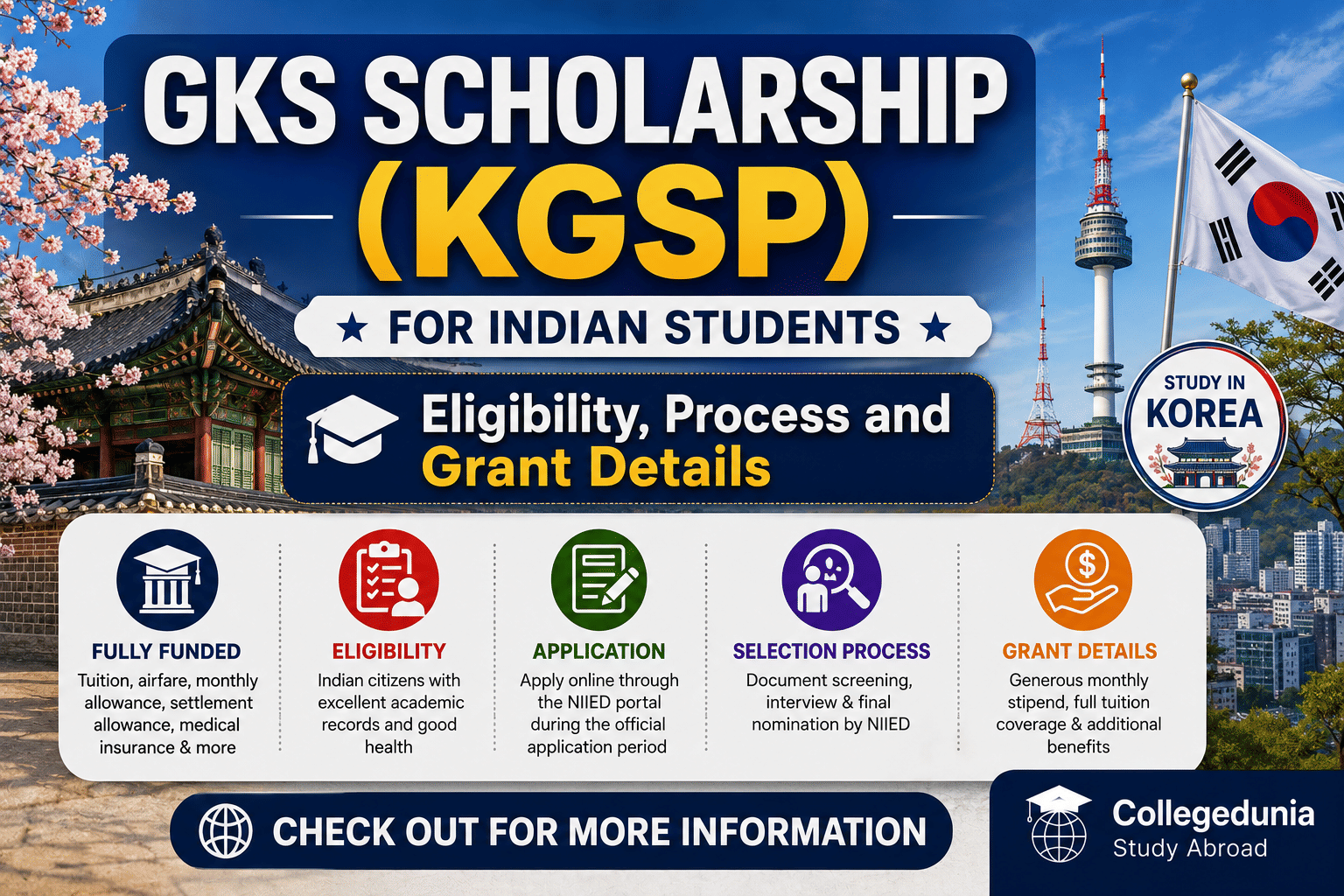
The GKS Scholarship for Indian students is South Korea's fully funded government award, formerly called KGSP. The National Institute for International Education runs it across undergraduate, master's and doctoral levels. It pays full tuition, a monthly stipend, round-trip airfare, insurance and a year of Korean language training.
- Two routes exist, the Embassy track and the University track, and filing for both disqualifies you.
- The Korean language year is part of the deal, waived only at TOPIK Level 5 or 6.
- Graduate stipends run KRW 1,000,000 a month, around INR 66,700, with research programmes higher.
- The academic bar is the top 20% of your class, read as roughly 80% marks.
About 1,500 students from over 150 countries win GKS each year. For the 2027 cycle, India's reported quota is 78 seats, split 50 University track and 28 Embassy track. The graduate cycle opens around February and the undergraduate cycle around September, so both 2027 cycles are close.
| Parameter | Detail |
|---|---|
| Provider | NIIED, Government of South Korea |
| Levels | Undergraduate, master's, doctoral and research |
| Graduate stipend | KRW 1,000,000 a month (around INR 66,700) |
| Research programme stipend | KRW 1,500,000 a month (around INR 1 lakh) |
| Tuition | Fully covered, capped at KRW 5 million a semester |
| Language training | One year, mandatory below TOPIK Level 5 |
| India quota 2027 | 78 reported, 50 University plus 28 Embassy |
| Graduate cycle | Opens around February, embassy deadline late February |
| Undergraduate cycle | Opens around September, results by January |
Must check,
- Scholarships to Study Abroad: Types, Eligibility, Award Value
- Fully Funded Scholarships for Indian Students to Study Abroad
- How can I study abroad for Free?
- Fully Funded MBA Scholarships for Indian Students Abroad
Highlights
| Scholarship Type | Merit-Based |
| Offered by | Government bodies |
| Organization | N/A |
| Application Deadline | N/A |
| Number of Scholarships | 367 |
| Amount | Variable Amount |
| Renewability | Yes, Yearly |
| International Student Eligible | Yes |
| Scholarship Website Link | https://gksscholarship.com/ |
Eligibility Criteria
Citizenship, class rank, and age windows decide GKS eligibility. The rules apply to your parents too.
Core criteria
- Both applicant and parents must be non-Korean citizens.
- Stand in the top 20% of your class, read as roughly 80% or a 2.64 CGPA on 4.0.
- Meet the age windows in the NIIED guidelines, commonly under 25 for undergraduate and under 40 for graduate entry.
- Hold, or be about to complete, the qualifying prior degree before arrival.
- Be in good health, physically and mentally, per the medical assessment.
Undergraduate applicants must finish the full school curriculum by 1 March of the selection year. Graduate applicants need the bachelor's or master's completed before the programme starts. Prior recipients of a Korean government scholarship face restrictions, so check the guideline PDF for your case.
Who fits poorly
- Applicants who cannot leave India for the language year plus the degree.
- Candidates below the class-rank bar, since screening enforces it strictly.
- Anyone planning to file both tracks, which ends in disqualification.
Application Process
You pick one track and live with the choice. The Embassy track gives three university choices, and the University track gives one.
Embassy track applicants file through the Korean Embassy in India and rank three universities. University track applicants apply directly to one participating Korean university. Forms come from the Study in Korea portal with each cycle's guideline. Documents need apostille and certified translations, so start that pipeline a month early.
Cycle timelines
| Stage | When it happens |
|---|---|
| Graduate cycle opens | Around February |
| Graduate embassy deadline | Late February (25 February in the 2026 cycle) |
| Undergraduate cycle opens | Around September |
| Undergraduate results | Around January |
| Arrival in Korea | Late February, before the March semester |
Standard document set
- The NIIED application form and personal statement.
- A study plan matched to the chosen universities.
- Transcripts and degree certificates, apostilled.
- Two recommendation letters.
- Citizenship proof for applicant and parents, passports or certificates.
NIIED rule that matters: each applicant may use only one track per cycle. Applying through both simultaneously results in disqualification.
Budget beyond the stipend for the first weeks, since payouts begin after arrival. Anchor the numbers with this cost of living comparison for students abroad.
Must check,
Selection Process
Selection runs in three rounds, ending with an NIIED decision. The Embassy track adds an interview layer in India.
Embassy track files are first screened by the Korean Embassy, and shortlisted candidates are interviewed. The embassy forwards its picks to NIIED for the second round. NIIED-cleared candidates then go to their ranked universities for admission review. University track files run through the university first, then NIIED confirms the final scholars.
Stage-wise flow
| Stage | What happens |
|---|---|
| First round | Embassy or university screens and interviews |
| Second round | NIIED committee reviews forwarded candidates |
| Third round | Universities confirm admission for embassy-track picks |
| Final list | NIIED announces scholars for the cycle |
| Pre-departure | Visa, medicals and language placement |
What the record shows: roughly 1,500 scholars win globally each year across 150 plus countries. India's reported 2027 quota is 78 seats across both tracks.
The study plan decides borderline files. Committees reward applicants who name professors, labs and courses at their ranked universities. Interview questions probe motivation for Korea specifically, so a generic study-abroad answer scores poorly.
Grant Details
GKS covers the degree end to end, language year included. Few government awards anywhere match its completeness.
What the award covers
- Full tuition, settled by NIIED and the university, capped at KRW 5 million a semester.
- A monthly stipend of KRW 1,000,000 for graduate scholars, around INR 66,700.
- KRW 1,500,000 a month for research programme scholars, around INR 1 lakh.
- A settlement allowance of KRW 200,000, around INR 13,300, on arrival.
- Round-trip economy airfare at actual cost.
- One year of Korean language training, with course fees covered.
- Medical insurance, plus research and dissertation printing support for graduate scholars.
Two toppers reward performance inside the award. TOPIK Level 5 or 6 holders earn an extra KRW 100,000 a month. A degree completion grant is also paid to scholars finishing on schedule.
What stays on you
- Daily costs beyond the stipend in expensive districts of Seoul.
- Dependant expenses, since the award funds the scholar alone.
- The commitment of the language year, which extends the total stay.
Also Check:
| Top Universities in the USA | Top Universities in the UK | Top Universities in Germany |
| Top Universities in Canada | Top Universities in Australia | UK Government Scholarships |
The GKS Scholarship suits Indian students who genuinely want Korea, language year and all. It pays for everything that matters and asks for academic rank plus commitment in return. Applicants treating Korea as a backup burn out during the language year. Serious candidates should pick one track, build a university-specific study plan and start apostilles now. The February and September clocks forgive nothing.
Similar Scholarship
SUBSCRIBE TO OUR NEWS LETTER


