



Education Journalist | Study Abroad Lead
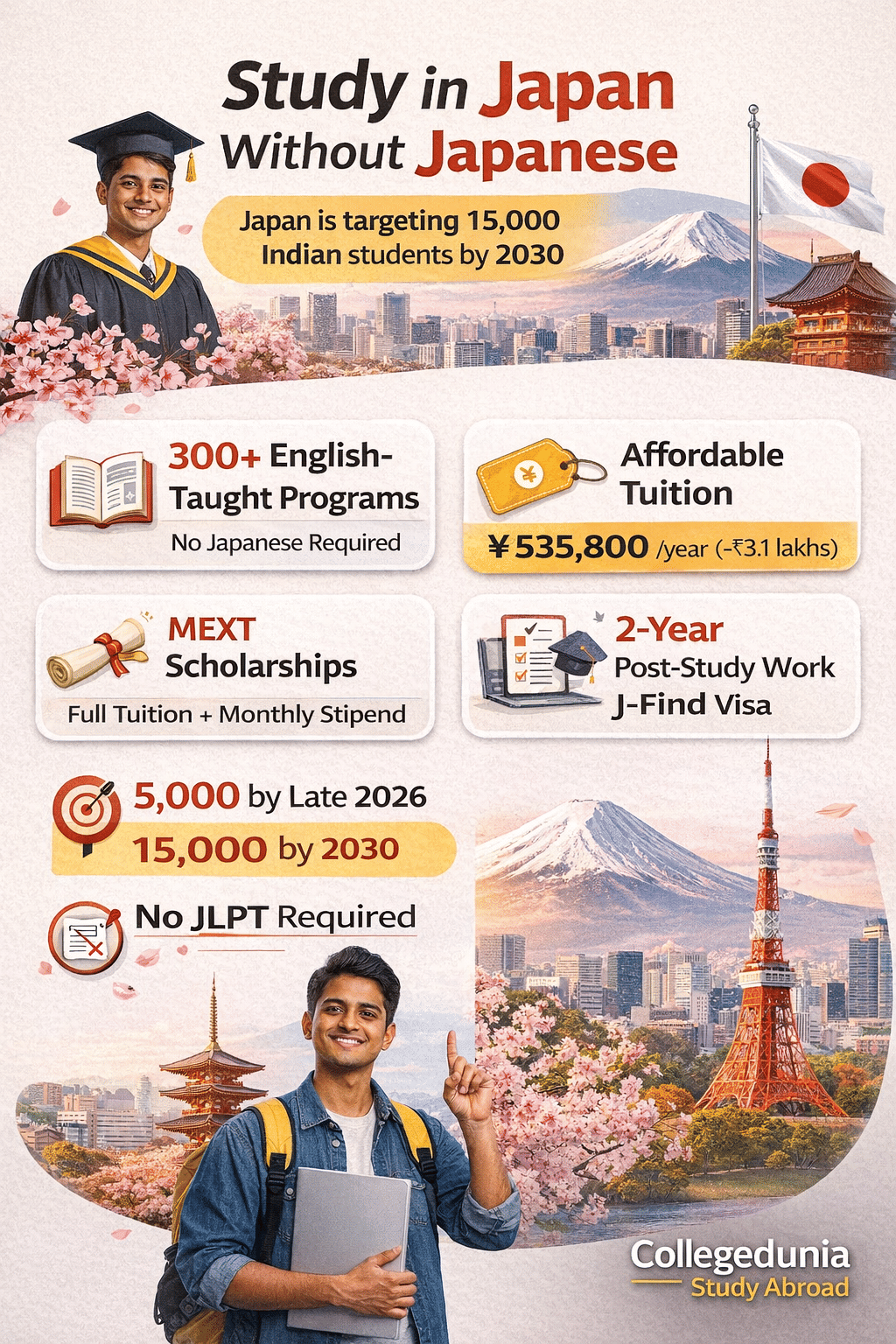
Japan is rapidly emerging as a premier study destination for Indian students, with over 300 English-taught degree programs across leading universities. The Japanese government aims to attract 15,000 Indian students by 2030. Unlike traditional study destinations, Japan offers world-class education at remarkably affordable costs - national universities charge just ¥535,800 annually (INR 3.1 lakhs), compared to INR 15-25 lakhs in the USA or UK. With generous MEXT scholarships covering full tuition and living allowances, a thriving job market for international graduates, and a 2-year post-study work visa, Japan presents a unique value proposition.
Can Indian Students Study in Japan Without Japanese Language?
Yes, absolutely. Indian students can pursue full degree programs in English without prior Japanese language knowledge.
Why Japan is Removing Language Barriers for Indian Students
Japan's Ministry of Education has launched a strategic initiative to internationalize higher education. According to the official Study in Japan portal, over 300 English-taught degree programs now exist across Japanese universities. The government's explicit goal is to welcome 5,000 Indian students by late 2026 and 15,000 by 2030.
Key Facts:
- 300+ English-taught programs available
- No JLPT (Japanese Language Proficiency Test) required for admission
- English-medium instruction at all major universities
- Growing international student communities (70+ nationalities at some campuses)
- Government scholarships specifically targeting international students
Top 10 English Taught Universities in Japan for Indian Students
The best universities in Japan for Indian students with English taught courses are as follows:
National Universities (Top-Ranked, Most Affordable)
National universities in Japan charge standardized fees (¥535,800 annually = INR 3.1 lakhs). These are the most affordable and prestigious options.
Top National Universities:
| University | QS Ranking 2026 | Annual Tuition (INR) | Popular English Programs | Intake Months | English Requirement |
|---|---|---|---|---|---|
| University of Tokyo | #36 | 3.1 lakhs | Global Science Course, Environmental Sciences, Public Policy | Sept/Oct | IELTS 7.0+ / TOEFL 100+ |
| Kyoto University | #57 | 3.1 lakhs | Civil Engineering, Biotechnology, AI & Robotics, Computer Engineering | April/Sept | IELTS 6.5+ / TOEFL 90+ |
| Osaka University | #91 | 3.1 lakhs | International Undergraduate Program (Science/Engineering), Robotics, Human Sciences | April/Sept | IELTS 6.0+ / TOEFL 80+ |
| Tohoku University | #109 | 3.1 lakhs | Future Global Leadership Program (Molecular Chemistry, Aerospace Engineering, Marine Biology) | October | IELTS 6.0+ / TOEFL 79+ |
| Nagoya University | #164 | 3.1 lakhs | Automotive Engineering, Biological Science, Law, Political Science | October | IELTS 6.5+ / TOEFL 90+ |
| Kyushu University | #170 | 3.1 lakhs | Bioresource and Bioenvironment, Interdisciplinary Science and Innovation | October | IELTS 6.0+ / TOEFL 80+ |
| Hiroshima University | #300+ | 3.1 lakhs | Integrated Global Studies (Culture, Peace, Environment) | April | IELTS 6.0+ / TOEFL 79+ |
Why Choose National Universities:
- Lowest tuition fees in Japan (¥535,800/year)
- World-class research facilities
- Strong international reputation
- Excellent MEXT scholarship eligibility
- Diverse student communities
Private Universities (Flexible Intake, International Focus)
Private universities offer more flexible admission timelines and often have larger international student populations. Fees are higher but still reasonable compared to Western universities.
Top Private Universities:
| University | QS Ranking 2026 | Annual Tuition (INR) | Popular English Programs | Intake Months | Specialization |
|---|---|---|---|---|---|
| Waseda University | #196 | 6.96+ lakhs | School of International Liberal Studies (SILS), Political Science, Economics, MBA | April/Sept | Liberal Arts, Business |
| Keio University | #215 | 6.84+ lakhs | GIGA (Global Information & Governance), PEARL (Economics) | September | Business, Economics |
| Sophia University | #300+ | 5-7 lakhs | Liberal Arts, Global Studies, Science & Technology, Sustainable Futures | April/Sept | Liberal Arts, Humanities |
Why Choose Private Universities:
- More flexible admission timelines (April and September)
- Larger international student communities
- Strong alumni networks
- Excellent career services
- More scholarship opportunities
Admission Requirements for English Taught Courses in Japan
English-taught programs have specific academic requirements. Most universities follow similar standards, though top-tier universities are more competitive.
Typical Academic Requirements:
| Requirement | Undergraduate Programs | Graduate Programs |
|---|---|---|
| 12th Grade Marks | 75-85% (depending on university tier) | N/A |
| GPA/CGPA | 3.0-3.5 out of 4.0 | 3.0-3.5 out of 4.0 |
| Standardized Tests | SAT 1200+ or ACT 26+ (for top universities) | GRE 300+ (for competitive programs) |
| Subject Requirements | Strong Math & Science for STEM programs | Relevant bachelor's degree |
| Work Experience | Not required | Preferred for MBA programs |
Key Points:
- Top universities (Tokyo, Kyoto, Osaka) are highly competitive
- Mid-tier universities accept students with 70-80% marks
- STEM programs require stronger math/science backgrounds
English Language Requirements for Admission
Most English-taught programs require IELTS or TOEFL scores, but not Japanese language proficiency.
Accepted English Tests:
| Test | Accepted By | Typical Requirement | Test Cost (INR) | Validity |
|---|---|---|---|---|
| IELTS Academic | All universities | 6.0-7.0 | 15,000-17,000 | 2 years |
| TOEFL iBT | All universities | 79-100 | 18,000-20,000 | 2 years |
| Duolingo English Test | Some universities | 100-120 | 5,000-6,000 | 2 years |
Important Note: While Japanese language is not required for admission, learning basic Japanese (N4-N3 level) is strongly recommended for:
- Part-time job opportunities
- Daily life convenience
- Long-term career prospects in Japan
- Social integration and friendships
Many universities offer free or subsidized Japanese language courses for international students.
Indian Student Experiences: Reddit Insights
Indian students opt for studying in Japan mainly because:
- Affordability: "National universities cost only ₹3.1 lakhs/year, cheaper than private colleges in India"
- Safety: "Japan is one of the safest countries; I feel secure studying alone"
- Career Opportunities: "Tech companies in Japan actively hire international graduates"
- Cultural Experience: "Studying in Japan gives unique cultural exposure and language skills"
- Post-Study Work: "The 2-year job-hunting visa gives enough time to find employment"
Student Testimonial: "I chose Japan over USA because the total 4-year cost is ₹40 lakhs vs ₹1.2 crores in the USA. Plus, I get to experience a completely different culture." -
Challenges Indian Students Face
Real challenges discussed by Indian students in Japan include:
- Language Barrier: English is fine for university, but daily life requires Japanese. Getting a part-time job is hard without Japanese language skills.
- Cultural Adjustment: Japanese work culture is very different; seniors expect respect and hierarchy
- Job Market Reality: Salary for international graduates is lower than in USA/UK. Tech companies like Google/Amazon pay well, but traditional Japanese companies pay less
- Financial Challenges: Accommodation in Tokyo is expensive. Healthcare costs add up.
Japan represents an exceptional opportunity for Indian students seeking world-class education at affordable costs. With over 300 English-taught programs, Japan is rapidly becoming an emerging study destination. The total 4-year cost of ₹40-55 lakhs is 2-3x cheaper than USA/UK, while offering comparable education quality and unique career advantages.
FAQs
Ques. Can I study in Japan without knowing Japanese?
Ans. Yes, absolutely. Over 300 English-taught degree programs exist at Japanese universities. You don't need Japanese language proficiency for admission. However, learning basic Japanese (N4-N3 level) is strongly recommended for daily life, part-time work, and long-term career prospects.
Ques. Is MEXT scholarship available for Indian students?
Ans. Yes, MEXT scholarship is available for Indian students through two routes:
- Embassy Recommendation (easier, ~20-30% success rate)
- University Recommendation (more competitive, ~10-15% success rate).
MEXT covers full tuition (¥535,800/year) + monthly stipend (¥144,000/month = ₹83,000) + airfare. Application deadline is May-June for April 2027 intake.
Ques. What is the job market like for international graduates in Japan?
Ans. 70-80% of international graduates secure jobs within 6 months.
- Average starting salary is ₹16.5-23 lakhs/year.
- Tech companies pay 30-50% more than traditional companies.
- Multinational companies pay 30-50% more than Japanese companies.
- The 2-year J-Find visa allows job hunting after graduation.
- Many graduates return to India after 2-3 years with 40-50% salary premiums.
Ques. What is the acceptance rate for Indian students?
Ans. Acceptance rates vary by university.
- Top universities (Tokyo, Kyoto, Osaka) have 10-20% acceptance rates for international students.
- Mid-tier universities have 30-50% acceptance rates.
- Emerging universities have 50-70% acceptance rates.
Overall, Indian students have good chances if they meet academic requirements (70%+ marks, IELTS 6.0+) and write strong applications.






Comments