



Study Abroad Content Writer | Updated On - Apr 24, 2026
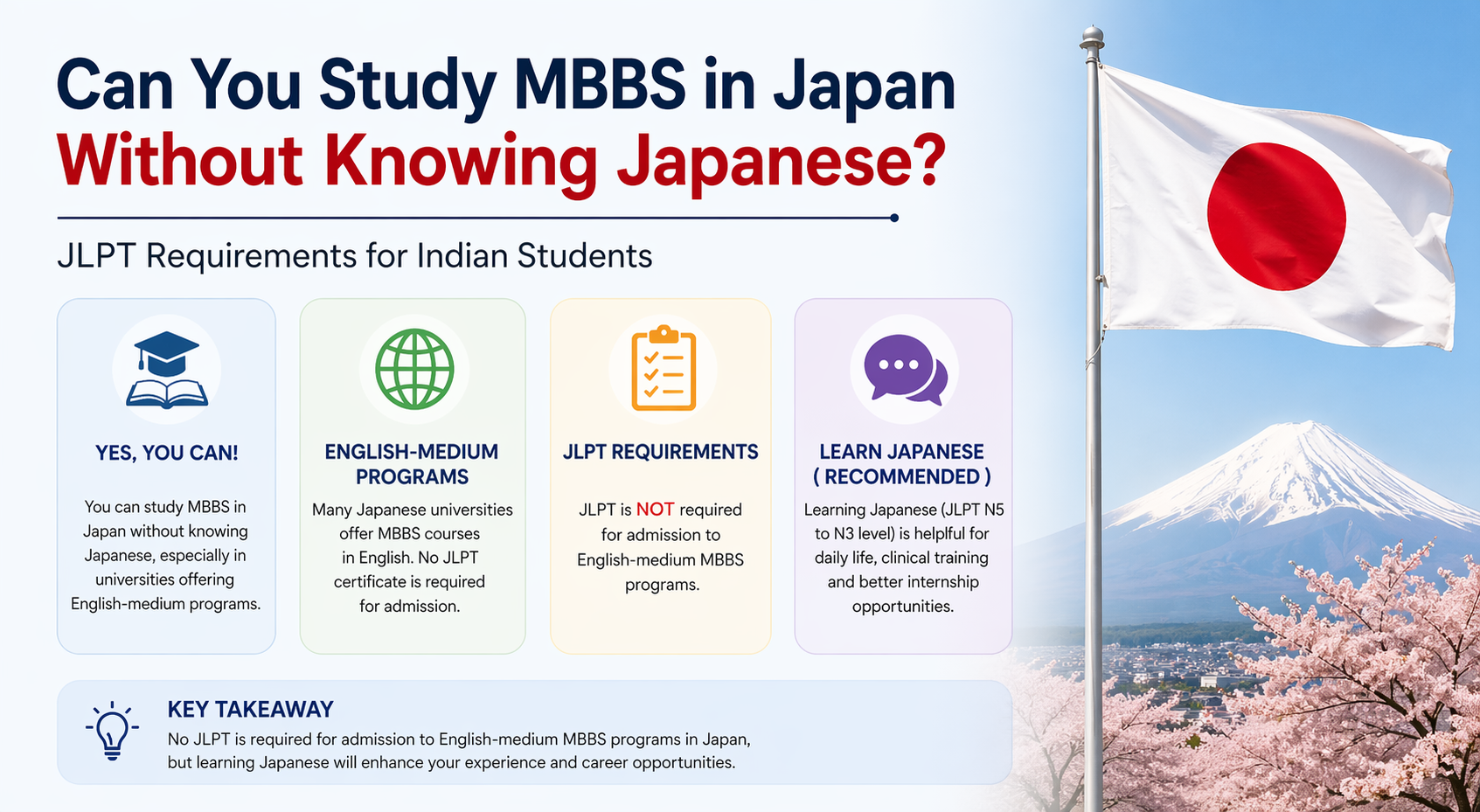
Many Indian students dream of studying MBBS in Japan. Japan has world-class medical universities, advanced hospitals, and a strong reputation for medical research. But one question stops most students: Can you study in Japan without knowing Japanese?
The short answer is: it depends on the university and the stage of your studies.
Key summary for the article:
- Whether JLPT is required to get admission to MBBS in Japan
- Which universities offer English-medium or partial English MBBS programs
- Why Japanese becomes unavoidable — even if you start in English
- What JLPT level you need to pass the Japanese Medical Licensing Exam
- Can You Study MBBS in Japan Without Knowing Japanese?
- What Is the JLPT and Why Does It Matter for MBBS in Japan?
- JLPT Requirements for MBBS in Japan: University-by-University Breakdown
- Universities in Japan Offering MBBS in English (or Partial English)
- Why Japanese Is Still Essential Even If JLPT Is Not Required at Admission?
- How Indian Students Can Prepare: Language Strategy for MBBS in Japan
- Step-by-Step Admission Process for Indian Students
- FAQs
Can You Study MBBS in Japan Without Knowing Japanese?
This is the most important question Indian students ask. The answer has two parts — admission and practice.
Most Indian students are surprised to learn that some top Japanese universities do not require JLPT at the time of admission. However, that does not mean you can complete your entire MBBS without learning Japanese.
Here is the key distinction every Indian student must understand:
- For admission: A few universities do not require JLPT. They accept TOEFL or IELTS instead.
- For clinical training (Year 3 onwards): Japanese becomes essential. Patients in Japan speak Japanese. Medical records are in Japanese. Clinical exams are in Japanese.
- For the Japanese National Medical Licensing Exam: The exam is entirely in Japanese. You must have near-native Japanese proficiency to pass it.
So while you can start MBBS in Japan without Japanese, you cannot complete it or practice medicine in Japan without learning the language.
What the Official Sources Say?
Official university guidelines confirm this clearly. The International University of Health and Welfare (IUHW) School of Medicine states in its April 2026 Application Guidelines:
"Our medical school conducts almost all classes in English until the end of Year 2. However, from Year 3, all classes are conducted in Japanese since you need to cope with clinical training in Japan and to pass the National Examination for Medical Practitioners in Japan." — IUHW School of Medicine, Official Application Guidelines, April 2026
The University of Tokyo's Medicine faculty listing on JPSS (Japan Study Support) confirms: "Japanese Language Proficiency Test (JLPT): Not necessary" for admission — but the EJU (Examination for Japanese University Admission for International Students) is required, and the medium of instruction shifts to Japanese in clinical years.
The Bottom Line for Indian Students
You can apply to MBBS in Japan without a JLPT certificate. But you must plan to learn Japanese — ideally reaching JLPT N2 or N1 level — before your clinical years begin.
What Is the JLPT and Why Does It Matter for MBBS in Japan?
Before diving into specific requirements, it helps to understand what the JLPT is and how its levels work. This context will help Indian students plan their language preparation realistically.
Understanding JLPT Levels
The JLPT (Japanese Language Proficiency Test) is the world's most widely recognized Japanese language certification. It is administered by the Japan Foundation and JASSO (Japan Student Services Organization).
The JLPT has five levels:
| JLPT Level | Proficiency Description | Approximate Study Hours |
|---|---|---|
| N5 | Basic Japanese — simple phrases and sentences | 150–200 hours |
| N4 | Basic Japanese — everyday conversations | 300–600 hours |
| N3 | Intermediate — can understand everyday Japanese | 450–900 hours |
| N2 | Upper-intermediate — can understand Japanese in most situations | 600–1,200 hours |
| N1 | Advanced — can understand Japanese in complex situations | 900–2,000+ hours |
Source: Japan Foundation, JLPT Official Website. Data may vary, check official website.
For MBBS students, N2 is the minimum practical level for clinical training. N1 is required to pass the Japanese National Medical Licensing Exam.
Why JLPT Matters for Medical Studies in Japan
The JLPT matters at three different stages of your MBBS journey in Japan:
- Stage 1 — Admission: Some universities require JLPT N2 or N3 for certain programs. Others do not require it at all.
- Stage 2 — Clinical Training (Year 3–6): You must communicate with Japanese-speaking patients, read Japanese medical records, and attend Japanese-language lectures.
- Stage 3 — Licensing Exam: The Japanese National Medical Licensing Exam (国家試験) is conducted entirely in Japanese. The Ministry of Health, Labour and Welfare (MHLW) requires foreign graduates to demonstrate Japanese language ability and clinical aptitude before sitting the exam.
JLPT Requirements for MBBS in Japan: University-by-University Breakdown
Different universities have different language requirements. This section gives you a clear, verified breakdown based on official university sources.
The table below shows JLPT requirements at the admission stage for key universities. Note that these are admission requirements only — clinical training and licensing will require higher Japanese proficiency regardless.
The following table is based on official university admission guidelines and JPSS (Japan Study Support) data, last updated in 2025–2026.
| University | JLPT Required at Admission | English Proficiency Required | Medium of Instruction |
|---|---|---|---|
| University of Tokyo (Medicine) | Not required | TOEFL or IELTS | Japanese (with EJU option in English) |
| University of Tsukuba (Medicine & Health Sciences) | Not required (Spring entry) | TOEFL or equivalent | Japanese (EJU in English available) |
| University of Tsukuba (Japan-Expert Program) | N3 or higher | — | Bilingual |
| IUHW School of Medicine | Not required at admission | TOEFL iBT 80+ or IELTS 6.0+ recommended | English (Years 1–2), Japanese (Years 3–6) |
| Kyushu University (Graduate Medical Sciences) | Not required | English proficiency required | English (graduate research program) |
Sources: JPSS official listings (Nov 2025, Jul 2025), IUHW Application Guidelines April 2026, Kyushu University Application Guidelines 2025. Data may vary, check official website.
Universities in Japan Offering MBBS in English (or Partial English)
Indian students often search for universities in Japan that offer MBBS in English. This section explains what is actually available — based on official sources only.
It is important to understand that Japan does not use the term "MBBS." The equivalent degree is called Doctor of Medicine (M.D.) and is awarded after a 6-year undergraduate medical program. For the purpose of this article, "MBBS in Japan" refers to this 6-year undergraduate medical degree.
IUHW School of Medicine — Japan's Only English-Medium Medical School
IUHW (International University of Health and Welfare) School of Medicine, located in Narita, Chiba, is the only medical school in Japan that formally teaches medicine in English. It was established in 2017 under Japan's National Strategic Special Zones program.
Key facts about IUHW (from official April 2026 Application Guidelines):
- Years 1–2: Almost all classes conducted in English
- Years 3–6: All classes conducted in Japanese (for clinical training and licensing exam preparation)
- JLPT at admission: Not required
- English requirement: TOEFL iBT 80+ or IELTS 6.0+ (recommended, not mandatory)
- Enrollment capacity for international students: 20 seats per year
- Outcome: 100% pass rate for international students in the Japanese National Medical Licensing Exam (first graduating class, 2023) — Source: IUHW academic paper, Researchmap, 2023
IUHW also offers an intensive Japanese language program for international students. Students who arrive with no Japanese knowledge are expected to reach approximately JLPT N2 level by the end of Year 2.
University of Tokyo — Medicine Faculty
The University of Tokyo is Japan's most prestigious national university. Its Medicine faculty accepts a small number of international students each year.
Key facts (Source: JPSS, updated November 2025):
- JLPT: Not required at admission
- English exam: TOEFL or IELTS required
- EJU: Required (can be taken in English or Japanese)
- Admission fee: JPY 282,000 (approximately ₹1.66 lakhs)
- Annual tuition: JPY 642,960 (approximately ₹3.79 lakhs per year)
- Seats for international students: A few (very limited)
University of Tsukuba — School of Medicine and Health Sciences
The University of Tsukuba is a leading national university in Ibaraki. It has a special entrance examination for students with foreign school experience.
Key facts (Source: JPSS, updated July 2025):
- JLPT: Not required for Spring entry (Special Entrance Examination for Students with Foreign School Experience)
- JLPT N3 required: For the Japan-Expert Program (Healthcare Course), Autumn entry
- English exam: TOEFL or equivalent
- Admission fee: JPY 282,000 (approximately ₹1.66 lakhs)
- Annual tuition: JPY 535,800 (approximately ₹3.16 lakhs per year)
- Seats for international students: 8 (for 2026 school year)
Kyushu University — Graduate School of Medical Sciences (English Program)
Kyushu University offers an English-medium International Education Research Course at the graduate level. This is a doctoral/research program, not an undergraduate MBBS equivalent.
Key facts (Source: Kyushu University Application Guidelines 2025):
- Language of instruction: English (no Japanese required)
- JLPT: Not required
- Enrollment: Approximately 10 students per year
- Tuition: JPY 535,800 per year (approximately ₹3.16 lakhs per year)
- Note: This is a graduate research program, not an undergraduate medical degree
Important: Indian students who want to practice medicine in Japan must complete the 6-year undergraduate medical program and pass the Japanese National Medical Licensing Exam. Graduate research programs alone do not qualify you to practice medicine in Japan.
Why Japanese Is Still Essential Even If JLPT Is Not Required at Admission?
Many Indian students make the mistake of thinking that "no JLPT required at admission" means they can complete their MBBS without learning Japanese. This section explains why that assumption is wrong — and what the real language demands look like.
Understanding this reality early will help Indian students plan their preparation properly and avoid wasting time and money.
Clinical Training Is in Japanese
From Year 3 onwards at almost all Japanese medical universities, clinical training takes place in Japanese hospitals. All patients speak Japanese. Medical records, prescriptions, and case notes are written in Japanese. Professors conduct rounds in Japanese.
Even at IUHW — Japan's only English-medium medical school — the official guidelines state clearly that from Year 3, all classes are in Japanese. This is because students must prepare for the Japanese National Medical Licensing Exam, which is entirely in Japanese.
The Japanese National Medical Licensing Exam Requires Near-Native Japanese
The Japanese National Medical Licensing Exam (国家試験, Kokka Shiken) is administered by the Ministry of Health, Labour and Welfare (MHLW). It is conducted entirely in Japanese.
According to the MADDJ (Medical Affairs Division for Doctors in Japan) official process guide:
- Foreign graduates must submit documents to the MHLW's Examination and License Division for eligibility review
- The Japanese Medical Examination Ability Survey tests whether candidates can: understand patients and healthcare professionals in Japanese, explain medical content accurately in Japanese, create basic medical records in Japanese, and read medical terminology in Japanese
- N1 certification results must be submitted as part of the application documents
This means that even if you were admitted to MBBS in Japan without any JLPT score, you must reach JLPT N1 level before you can sit the licensing exam and practice medicine in Japan.
IUHW's Real-World Evidence
The IUHW academic paper (published in the Journal of International Medical Education, 2023) provides the most concrete evidence of what is possible. International students at IUHW arrived with no Japanese knowledge and:
- Reached approximately JLPT N3 level by the time they started medical school (after 3–6 months of intensive Japanese)
- Reached approximately JLPT N2 level by the end of Year 1
- Many reached JLPT N1 during their first three years
- All 15 international students in the first graduating class (2023) passed the Japanese National Medical Licensing Exam
This shows that it is possible to learn Japanese from scratch and pass the licensing exam — but it requires enormous dedication and structured language training.
How Indian Students Can Prepare: Language Strategy for MBBS in Japan
Knowing the language requirements is one thing. Having a clear preparation plan is another. This section gives Indian students a practical roadmap for language preparation.
The good news is that Indian students who start Japanese early have a significant advantage. Starting before you even apply can make the difference between struggling in clinical years and thriving.
Recommended Language Timeline for Indian Students
Here is a realistic preparation timeline based on JLPT level requirements:
| Stage | Target JLPT Level | Recommended Timeline | Purpose |
|---|---|---|---|
| Before applying | N5 or N4 | 6–12 months before application | Shows initiative; helps with EJU Japanese section |
| Year 1–2 (at university) | N3 to N2 | During first two years | Clinical communication basics |
| Year 3–4 | N2 to N1 | During clinical years | Medical Japanese, patient interaction |
| Year 5–6 | N1 (solid) | Before licensing exam | Pass Japanese National Medical Licensing Exam |
Note: IUHW provides 420 hours of structured Japanese language instruction during Years 1–2 for international students. Source: IUHW academic paper, 2023.
Practical Tips for Indian Students
Starting Japanese preparation before arriving in Japan gives you a head start. Here are practical steps:
- Start with N5 and N4: These levels cover basic grammar and vocabulary. Many free and paid resources are available in India.
- Use JLPT-specific study materials: The Japan Foundation publishes official JLPT preparation materials.
- Practice medical Japanese separately: Medical terminology in Japanese is different from everyday Japanese. Start learning it from Year 2 onwards.
- Use the EJU Japanese section as a benchmark: The EJU (Examination for Japanese University Admission for International Students) has a Japanese as a Foreign Language section. Scoring well here demonstrates readiness.
- Enroll in a Japanese language school in Japan: Many universities recommend arriving 3–6 months early to attend an intensive Japanese language program.
Step-by-Step Admission Process for Indian Students
Applying to MBBS in Japan involves several steps. This section gives Indian students a clear, sequential guide to the process.
The admission process differs slightly between national universities and private universities like IUHW. The steps below cover the general process applicable to most universities.
Step 1: Check Eligibility
Before applying, confirm you meet the basic eligibility criteria:
- Completed 12 years of schooling outside Japan (or equivalent)
- Strong academic record in Physics, Chemistry, and Biology
- Valid NEET score (mandatory for Indian students applying to foreign medical universities, as per NMC guidelines)
- English proficiency: TOEFL iBT 80+ or IELTS 6.0+ (for most universities)
- No Japanese nationality or permanent residency in Japan (for international student category)
Step 2: Appear for the EJU (Examination for Japanese University Admission for International Students)
The EJU is required by most Japanese national universities for international student admissions. It tests Japanese as a Foreign Language, Mathematics, and Science subjects.
- Administered by: JASSO (Japan Student Services Organization)
- Language options: Japanese or English for most subjects
- Frequency: Twice a year (June and November)
- Website: www.jasso.go.jp/ryugaku/eju/
Step 3: Apply to Your Chosen University
Each university has its own application process and deadlines. Key points:
- IUHW: Online application only; two rounds per year (First Round: August–September; Second Round: November–December)
- University of Tokyo: Application period December 1–5, 2025 (for April 2026 entry); exam in February–March 2026
- University of Tsukuba: Application period October 3–9, 2025 (for April 2026 entry); exam in November 2025
Step 4: Appear for the Entrance Examination
Most universities conduct a two-phase screening:
- Phase 1: Written exam (Science, Mathematics, English) + Essay
- Phase 2: Individual interview (conducted in English at IUHW; in English or Japanese at national universities)
Step 5: Apply for Student Visa
After receiving your admission letter:
- Apply for a Student (Ryugaku) Visa at the Japanese Embassy or Consulate in India
- Required documents include: Certificate of Eligibility (issued by your university), admission letter, financial proof, passport, and photographs
- Processing time: Approximately 4–6 weeks
Step 6: Enroll and Begin Japanese Language Preparation
After arriving in Japan:
- Enroll in your university's Japanese language program
- IUHW provides 420 hours of Japanese instruction during Years 1–2
- National university students should enroll in additional Japanese language courses
- Aim to reach JLPT N2 by the end of Year 2 and N1 before your licensing exam
Overall, Indian student can practice medicine in Japan after completing the 6-year medical degree and passing the Japanese National Medical Licensing Exam. However, this exam is conducted entirely in Japanese and requires JLPT N1-level proficiency. Foreign graduates must also submit documents to Japan's Ministry of Health, Labour and Welfare (MHLW) for eligibility review, and may need to pass a Japanese Medical Examination Ability Survey before sitting the main licensing exam.
FAQs
Ques. Can Indian students study MBBS in Japan without knowing Japanese?
Ans. Yes, Indian students can gain admission to some Japanese medical universities without a JLPT certificate, but they cannot complete their MBBS or practice medicine in Japan without learning Japanese. Universities like IUHW teach the first two years in English, but from Year 3 onwards, all instruction shifts to Japanese. The Japanese National Medical Licensing Exam is conducted entirely in Japanese and requires near-native proficiency.
Ques. Is there any university in Japan that offers MBBS fully in English?
Ans. No university in Japan offers a complete 6-year MBBS program fully in English. IUHW School of Medicine is the only university that teaches medicine in English for the first two years. From Year 3, all instruction shifts to Japanese for clinical training and licensing exam preparation. Graduate research programs at universities like Kyushu University are taught in English, but these do not qualify graduates to practice medicine in Japan.
Ques.Do Indian students need NEET to study MBBS in Japan?
Ans. Yes, Indian students must have a valid NEET score to study MBBS in any foreign country, as per the National Medical Commission (NMC) of India guidelines. This is a requirement from the Indian side, not from Japanese universities. Japanese universities have their own entrance examinations (EJU, written science/math tests, and interviews) that Indian students must also clear separately.
Ques. How long does it take to learn Japanese well enough for MBBS in Japan?
Ans. Reaching JLPT N2 level (the minimum for clinical training) typically requires 600–1,200 hours of study. Reaching JLPT N1 (required for the licensing exam) requires 900–2,000+ hours. IUHW's experience shows that international students who arrive with no Japanese knowledge can reach approximately N2 level within one year of intensive study (420 hours of structured classes plus self-study). Starting Japanese preparation 6–12 months before arriving in Japan gives Indian students a significant advantage.






Comments