



Philipps University Marburg Fees for Indian Students 2027: Tuition Fees, Cost of Living & Scholarships


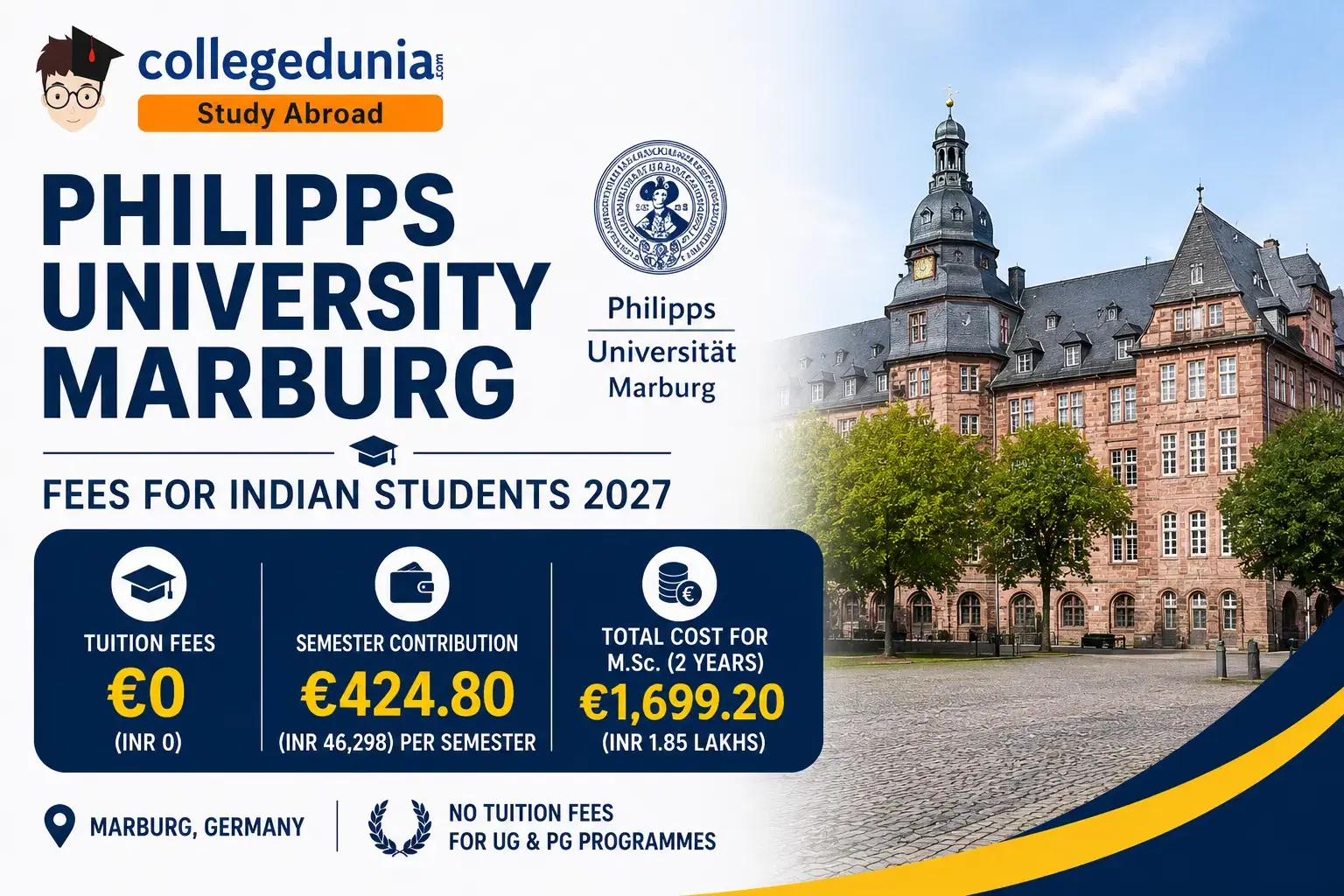
Philipps University Marburg fees for Indian students are limited to a semester contribution of €424.80 (₹46,298) per semester, since the university charges no tuition for undergraduate or postgraduate degrees. That works out to €849.60 (₹92,596) per year for an M.Sc. Psychology, M.Sc. Data Science, or M.Sc. Computer Science, the three programmes drawing most Indian applicants.
Your realistic entry is the Winter Semester 2027/28 intake, which most Masters at Philipps University Marburg start in. Summer Semester 2027 remains open for a shorter list of programmes but the January 2027 deadline is close, so Winter 2027/28 is where planning effort should sit.
- UG semester fee: €424.80 (₹46,298) per semester, no tuition charged
- PG standard semester fee: €424.80 (₹46,298) per semester, no tuition charged
- Two-year M.Sc. total fees: €1,699.20 (₹1.85 Lakhs), across four semesters
- Blocked account requirement: €11,904 (₹10.95 Lakhs), refunded to you monthly in Germany
- Deutschlandstipendium award: €3,600 (₹3.31 Lakhs) per year for high performers
A full two-year M.Sc. at Marburg costs an Indian student roughly ₹12 Lakhs to ₹13 Lakhs including living, health insurance, and visa costs, one of the lowest all-in Masters budgets in Europe. A three-year B.Sc. Biomedical Science sits closer to ₹13 Lakhs to ₹14 Lakhs total.
Exchange rate: 1 EUR = ₹109 as of July 28, 2027
Winter Semester 2027/28 Intake: Planning Cycle Open
- Intake: Winter Semester 2027/28 is the main intake for Indian students at Marburg, with applications opening April 2027 and closing 15 July 2027 for most Masters. Summer Semester 2027 remains open for a limited set of programmes with a 15 January 2027 deadline, but the Data Science, Computer Science, and Psychology Masters admit only in winter.
- When to pay: The semester contribution is due at enrolment, not at application, so nothing leaves your account until you have the admission letter. The full instalment schedule, methods, and step-by-step process live in the payment section below.
- Scholarships: Deutschlandstipendium applications reopen in June 2027 for Winter 2027/28 entrants. External Indian awards (Inlaks, JN Tata, KC Mahindra) all close between March and April 2027, so budget that as your active window for external funding.
Also Check: Philipps University Marburg Admissions for Indian Students
Table of Contents
- Philipps University Marburg Tuition Fees by Programme
- Philipps University Marburg Fee Trend by Year
- Cost of Living in Marburg for Philipps University Marburg Indian Students
- Total Cost of Studying at Philipps University Marburg
- Philipps University Marburg Scholarships for Indian Students
- Philipps University Marburg Semester Fee Payment and Blocked Account
- Hidden Costs of Studying at Philipps University Marburg
- Fee Saving Strategies for Philipps University Marburg Indian Students
- Is Philipps University Marburg Worth the Cost for Indian Students
- Philipps University Marburg Fees FAQs
Philipps University Marburg Tuition Fees by Programme
Philipps University Marburg charges no tuition for any degree, at any level, for any nationality. Every enrolled student pays a single semester contribution of €424.80 (₹46,298) that covers university services, the student union, and the semester transport ticket valid across Germany.
Philipps University Marburg Undergraduate Fees for Indian Students
Bachelor programmes run six semesters, so the total three-year fee cost is €2,548.80 (₹2.77 Lakhs). Marburg’s B.Sc. Biomedical Science is the most-applied UG course by Indian students, though most Bachelors are taught in German and require a C1 language certificate.
| Programme | Duration | Semester Fee (EUR) | Total Programme Fee (INR) |
|---|---|---|---|
| B.Sc. Biomedical Science | 6 semesters | €424.80 | ₹46,298 |
| B.Sc. Biology | 6 semesters | €424.80 | ₹46,298 |
| B.Sc. Chemistry | 6 semesters | €424.80 | ₹46,298 |
| B.Sc. Physics | 6 semesters | €424.80 | ₹46,298 |
| B.Sc. Computer Science | 6 semesters | €424.80 | ₹46,298 |
Philipps University Marburg Postgraduate Fees for Indian Students
Masters run four semesters, taking total fees to €3,224 (₹2.97 Lakhs) across the entire degree. Marburg offers 64 English-taught Masters programmes; the five most-applied by Indian students are shown below.
| Programme | Duration | Semester Fee (EUR) | Total Programme Fee (INR) |
|---|---|---|---|
| M.Sc. Psychology | 4 semesters | €424.80 | ₹46,298 |
| M.Sc. Data Science | 4 semesters | €424.80 | ₹46,298 |
| M.Sc. Computer Science | 4 semesters | €424.80 | ₹46,298 |
| M.Sc. Biomedical Science | 4 semesters | €424.80 | ₹46,298 |
| M.Sc. Chemistry | 4 semesters | €424.80 | ₹46,298 |
Application to Marburg for Indian students runs through uni-assist, the centralised German application service. The uni-assist fee is €75 (₹6,900) for the first programme and €30 (₹2,760) for each additional programme applied to in the same semester.
Note: The €806 semester contribution is not tuition, it is an administrative and transport fee. It includes the Deutschlandticket, which lets you travel on all regional public transport across Germany at no extra cost. For a Winter 2027/28 entrant, that ticket alone would otherwise cost €49 (₹4,508) per month.
Philipps University Marburg Fee Trend by Year
Tuition at Marburg has been €0 for every year of the past decade, in line with Hesse state’s policy of free public higher education. Only the semester contribution has drifted upward, driven almost entirely by the transport ticket component.
| Academic Year | Tuition (EUR) | Semester Contribution (EUR) | Annual Total (INR) |
|---|---|---|---|
| 2022/23 | €0 | €312 | ₹57,408 |
| 2023/24 | €0 | €332 | ₹61,088 |
| 2024/25 | €0 | €780 | ₹1.43 Lakhs |
| 2025/26 | €0 | €795 | ₹1.46 Lakhs |
| 2026/27 | €0 | €424.80 | ₹46,298 |
Key Insight: Enrolling in Winter Semester 2027/28 locks you into a per-semester contribution likely to rise by around 2% to roughly €822 (₹75,624), still under ₹1.52 Lakhs for the full year. That fee stability is the biggest single financial advantage Marburg holds over UK or US options, where annual increases run 4% to 8%.
Cost of Living in Marburg for Philipps University Marburg Indian Students
Living in Marburg costs an Indian student between €800 (₹73,600) and €950 (₹87,400) per month, materially lower than Berlin, Munich, or Frankfurt. Marburg is a compact university town of 76,000 residents where most students walk or cycle to campus, so the semester ticket is a bonus rather than a necessity.
| Expense | Monthly (EUR) | Monthly (INR) | Annual (INR) | Notes for Indian Students |
|---|---|---|---|---|
| Student Hall or WG Room | €350 | ₹32,200 | ₹3.86 Lakhs | Studierendenwerk halls are the cheapest option; apply months before arrival |
| Food and Groceries | €220 | ₹20,240 | ₹2.43 Lakhs | Mensa lunches at €3 to €5; Indian groceries available at REWE and Turkish stores |
| Health Insurance (Public) | €125 | ₹11,500 | ₹1.38 Lakhs | Mandatory for enrolment; TK, AOK, and Barmer are the main providers |
| Utilities and Internet | €80 | ₹7,360 | ₹88,320 | Often bundled into WG rent; check the "warm" versus "cold" rent distinction |
| Personal, Books, Leisure | €100 | ₹9,200 | ₹1.10 Lakhs | Broadcasting fee (Rundfunkbeitrag) at €18.36 per month is mandatory per household |
Also read: Cost of Living in Germany
The German student visa requires proof of €11,904 (₹10.95 Lakhs) per year in a blocked account, which is what the government considers the minimum a student needs to live on for 12 months. That works out to €992 (₹91,264) per month, marginally higher than the realistic Marburg cost above, so the blocked amount comfortably covers small-town living.
Note: Marburg’s Studierendenwerk operates seven halls of residence with rents from €270 (₹24,840) to €410 (₹37,720) per month, all utilities included. Apply through the Studierendenwerk portal within a week of receiving your admission letter, since spots fill quickly for Winter Semester 2027/28 arrivals.
Rent contracts in Germany often use "warm" and "cold" rent terminology, where cold rent excludes utilities and warm rent includes heating, water, and building maintenance. Ask the landlord which figure was quoted before signing, since the gap between the two can be €100 (₹9,200) per month.
Currency Tip: Fund your blocked account in one wire transfer before the visa appointment for Winter 2027/28. Providers like Expatrio and Fintiba charge €89 (₹8,188) flat versus the 3% to 4% forex spread most Indian banks apply on a raw wire, which on ₹11 Lakhs is a saving of over ₹30,000.
Total Cost of Studying at Philipps University Marburg
Total first-year cost for an Indian Masters student at Marburg is ₹12.5 Lakhs to ₹14 Lakhs, which is a fraction of what a comparable UK, US, or Australian Masters would cost. The two-year all-in figure sits around ₹22 Lakhs to ₹24 Lakhs, low enough that a standard Indian education loan of ₹25 Lakhs covers the entire programme with a buffer.
| Scenario | Tuition (INR) | Semester Fees (INR) | Living (12 months, INR) | Mandatory Fees (INR) | Total Year 1 (INR) |
|---|---|---|---|---|---|
| M.Sc. Budget | ₹0 | ₹46,298 | ₹9.36 Lakhs | ₹1.65 Lakhs | ₹9.82 Lakhs |
| M.Sc. Moderate | ₹0 | ₹46,298 | ₹10.80 Lakhs | ₹1.65 Lakhs | ₹12.91 Lakhs |
| B.Sc. Budget (Year 1) | ₹0 | ₹46,298 | ₹9.36 Lakhs | ₹1.65 Lakhs | ₹11.47 Lakhs |
Mandatory Fees line covers health insurance for 12 months (₹1.38 Lakhs), student visa fee (₹6,900), APS certification (₹18,000), and uni-assist processing (₹6,900). Living is calculated on 12 months for both UG and PG since German programmes do not follow the 10-month academic year model.
Full two-year Masters total lands at ₹22 Lakhs to ₹24 Lakhs, or roughly ₹0.22 Crore. An education loan of ₹20 Lakhs at 10.5% over 10 years works out to an EMI of around ₹27,000 per month, well within the reach of a first-year graduate earning €48,000 (₹44 Lakhs) in Germany post-degree. Know more about cost of studying in Germany.
Key Insight: A Deutschlandstipendium award of €3,600 (₹3.31 Lakhs) per year, combined with a Werkstudent job paying €520 (₹47,840) monthly, cuts your net two-year outlay to roughly ₹8 Lakhs to ₹10 Lakhs. Lock the Deutschlandstipendium application in your Winter 2027/28 first-semester calendar, applications reopen in June 2027.
Philipps University Marburg Scholarships for Indian Students
Marburg has no university-wide tuition scholarship because there is no tuition to waive, so scholarship value here means cash stipends that offset living costs. The four routes worth pursuing for Winter Semester 2027/28 are Deutschlandstipendium, DAAD, STIBET, and the standard external Indian awards.
Philipps University Marburg Institutional Scholarships
| Scholarship | Annual Value | Eligibility | Application Window |
|---|---|---|---|
| Deutschlandstipendium | €3,600 (₹3.31 Lakhs) | All enrolled students with strong academic record, open to Indian applicants | June 2027 for Winter 2027/28 entrants |
| STIBET I Merit Award | €3,000 (₹2.76 Lakhs) | International Masters and doctoral students at Marburg | Rolling; apply after first semester |
| STIBET Graduation Grant | €800 (₹73,600) one-time | International students in final thesis semester | Apply through International Office |
DAAD and External Scholarships for Philipps University Marburg
DAAD and Indian trust scholarships are the highest-value routes for Indian students. All four external Indian awards below are open for Winter 2027/28 with deadlines between March and April 2027.
| Scholarship | Annual Value | Deadline (Winter 2027/28) | Notes |
|---|---|---|---|
| DAAD Study Scholarship | €992 (₹91,264) per month, plus tuition, plus travel | 15 October 2026 (for October 2027 entry) | Highest-value award; covers full living cost plus health insurance |
| Inlaks Shivdasani Scholarship | Up to USD 100,000 (₹85.7 Lakhs) total | Mid-March 2027 | Age limit 30; strong CV essential |
| JN Tata Endowment Loan Scholarship | Up to ₹10 Lakhs loan plus ₹1 Lakh gift | Mid-March 2027 | Low-interest, income-linked repayment |
| KC Mahindra Scholarship | Up to ₹10 Lakhs | End March 2027 | Interest-free loan-scholarship |
| Narotam Sekhsaria Foundation | Up to ₹20 Lakhs interest-free loan | April 2027 | Convertible to grant on strong performance |
Tip for Indian Students: Prioritise the DAAD Study Scholarship for Winter 2027/28 with the 15 October 2026 deadline, since it covers your entire €992 monthly living cost and effectively cancels the need for a blocked account. If DAAD is not secured, layer the Inlaks or JN Tata application in March 2027 as your backup funding route.
Philipps University Marburg Semester Fee Payment and Blocked Account
Marburg does not charge a tuition deposit because there is no tuition. Your only upfront financial commitment is the blocked account of €11,904 (₹10.95 Lakhs), funded before the visa appointment, and the semester contribution of €806 (₹74,152) paid at enrolment. The blocked account is fully refundable to you; it is drawn down monthly as living money once you land.
Methods of Payment for Philipps University Marburg
- Blocked account providers: Fintiba, Expatrio, Coracle, and Deutsche Bank all accept Indian wire transfers, with setup fees of €89 (₹8,188) to €150 (₹13,800)
- SEPA bank transfer: Standard method for the semester fee once you hold a German bank account (typically opened in your first week)
- International wire (SWIFT): Backup for the first semester fee if your German account is not yet active; adds €15 to €30 (₹1,380 to ₹2,760) in bank charges
- Forex card: Not accepted for semester fees, but useful for the first two weeks of living expenses; Niyo, Wise, and BookMyForex give the best inter-bank rates
- Education loan disbursement: Public-sector Indian bank loans can wire directly to Fintiba or Expatrio; keep the loan sanction letter ready for the visa file
Steps to Pay Fees at Philipps University Marburg for International Students
- Accept the admission letter through the uni-assist or Marburg admissions portal within two weeks of receiving it
- Open a blocked account with Fintiba or Expatrio and wire €11,904 (₹10.95 Lakhs) from your Indian bank
- Take health insurance confirmation from TK, AOK, or Barmer, cost €125 (₹11,500) per month
- Attend the visa appointment at the German Consulate (Delhi, Mumbai, Chennai, Kolkata, or Bengaluru); processing runs 8 to 12 weeks
- Land in Marburg, complete address registration (Anmeldung) within two weeks, then open a German bank account
- Pay the semester contribution of €424.80 (₹46,298) via SEPA transfer to complete enrolment
- Keep every receipt (blocked account, health insurance, semester fee) in a folder for future visa extensions
Tip for Indian Students: Fund the blocked account by 15 April 2027 for a Winter 2027/28 start, so your German consulate appointment falls in May or June 2027 and the visa lands well before the October 2027 enrolment deadline. Wire transfers to Fintiba or Expatrio take 3 to 5 working days, factor that lead time into your calendar.
Hidden Costs of Studying at Philipps University Marburg
The single most-forgotten cost for Winter Semester 2027/28 applicants is the APS certification, mandatory for all Indian students applying to German universities. Missing it delays your uni-assist application by weeks.
- APS certificate: Mandatory pre-application academic verification for Indian applicants, ₹18,000, processing takes 3 to 4 weeks
- uni-assist processing fee: €75 (₹6,900) for the first programme, €30 (₹2,760) per additional programme
- Student visa fee: €75 (₹6,900) paid at the German consulate
- Blocked account opening fee: €89 to €150 (₹8,188 to ₹13,800) at Fintiba or Expatrio
- Health insurance: €125 (₹11,500) per month, upfront quarterly payment often expected
- Anmeldung and residence permit: €100 to €110 (₹9,200 to ₹10,120) for the first residence permit after arrival
- Broadcasting fee (Rundfunkbeitrag): €18.36 (₹1,689) per month per household, non-negotiable
- IELTS or TestDaF: ₹17,000 per attempt if not already held
- Flight to Frankfurt: ₹40,000 to ₹65,000 one-way from major Indian cities
Budget approximately ₹1.65 Lakhs to ₹2 Lakhs for first-year hidden costs beyond tuition and living.
Note: The one hidden cost most Indian families forget is the German broadcasting fee, Rundfunkbeitrag, at €18.36 (₹1,689) per month. It is charged per apartment, not per person, so if you share a WG the total is split; if you live alone in a studio, it falls entirely on you, adding ₹20,000 a year.
Fee Saving Strategies for Philipps University Marburg Indian Students
The most urgent saving lever for Winter Semester 2027/28 is the DAAD Study Scholarship with a 15 October 2026 deadline, which cancels your blocked account requirement if awarded.
- Werkstudent job: Indian students can work 20 hours a week during semester and full-time during breaks, earning around €520 (₹47,840) monthly at minimum wage, or over €6,000 (₹5.52 Lakhs) per year, which effectively covers your entire living cost
- WG (shared apartment): Choosing a Wohngemeinschaft over a single studio cuts rent from €500 (₹46,000) to €350 (₹32,200) per month, saving ₹1.66 Lakhs a year
- Mensa lunches: University canteen meals at €3 to €5 (₹276 to ₹460) versus €10 to €12 (₹920 to ₹1,104) for cafe lunches; saves ₹40,000 a year if used daily
- Section 80E tax deduction: Interest on your Indian education loan is 100% deductible from taxable income for 8 years, meaningful for graduates earning ₹10 Lakhs plus back home
- 18-month job seeker stay: Germany grants an 18-month post-study residence permit for Masters graduates, letting you earn €48,000 to €55,000 (₹44 Lakhs to ₹50 Lakhs) in your first year and start loan repayment fast
Tip for Indian Students: A Werkstudent job locked in by month three of Winter Semester 2027/28 delivers roughly ₹5.5 Lakhs a year, which by itself covers 45% of your annual cost at Marburg. Register with the university’s career portal in your first week and target lab-assistant, IT support, or research-assistant roles on campus.
Is Philipps University Marburg Worth the Cost for Indian Students?
Yes, Philipps University Marburg is worth the cost for Indian students, with a total two-year Masters outlay of ₹22 Lakhs to ₹24 Lakhs against a realistic first-year German graduate salary of €48,000 to €55,000 (₹44 Lakhs to ₹50 Lakhs). Payback on a ₹20 Lakh education loan takes roughly 4 to 5 years, one of the fastest in Europe for a public university.
Academically, Marburg is ranked 951-1000 in QS World University Rankings 2027 and 401-500 in Times Higher Education World University Rankings 2026, with subject strength in Medicine (QS Global rank 351, 12th in Germany) and Psychology (THE 251-300, ARWU 76-100). ARWU 2025 places the university in the global 301-400 band overall, and 8th in Germany. Check ranking analysis for more information.
Post-study rights in Germany are among the strongest in Europe: an 18-month job seeker residence permit after graduation, transitioning to an EU Blue Card once you secure a salaried role above €45,300 (₹41.68 Lakhs) per year. Loan EMI on ₹20 Lakhs at 10.5% over 10 years is around ₹27,000 per month, well below 10% of a Blue Card salary.
Key Insight: The single number that makes Winter Semester 2027/28 at Marburg a sound decision is the net cost after a Werkstudent job and Deutschlandstipendium: roughly ₹8 Lakhs to ₹10 Lakhs over two years, or under ₹42,000 a month effective spend. That is less than the monthly EMI on a comparable UK or US Masters loan.
Philipps University Marburg is one of the most affordable Masters routes in Europe for Indian students, with a two-year all-in budget of ₹22 Lakhs to ₹24 Lakhs and zero tuition. For Winter Semester 2027/28 planning, front-load the DAAD Study Scholarship application in October 2026, secure your APS certificate by January 2027, and fund the blocked account by April 2027 so the visa lands with a comfortable buffer. Aim to lock a Werkstudent job in your first month on campus and apply for the Deutschlandstipendium in June 2027 to cut your net outlay to under ₹10 Lakhs.
FAQs
Ques. What is the total fee for an Indian student at Philipps University Marburg?
Ans. The total fee for a two-year Masters at Philipps University Marburg is €3,224 (₹2.97 Lakhs), comprising four semester contributions of €806 each. The university charges no tuition, so this contribution covers only student services and the Deutschlandticket transport pass.
Ques. Does Philipps University Marburg charge tuition fees for international students?
Ans. No, Philipps University Marburg charges zero tuition for both German and international students at UG and PG levels, in line with Hesse state policy. The only mandatory fee is the semester contribution of €806 (₹74,152).
Ques. How much money do I need in a blocked account to study at Marburg for Winter Semester 2027/28?
Ans. You need €11,904 (₹10.95 Lakhs) in a German blocked account for the Winter 2027/28 intake, at the current €992 per month rate for 12 months. The amount is fully yours; it is drawn down monthly as living money once you arrive.
Ques. What is the cost of living in Marburg for an Indian student?
Ans. Living in Marburg costs €800 (₹73,600) to €950 (₹87,400) per month, covering rent, food, health insurance, utilities, and personal expenses. Total annual living cost lands between ₹9.36 Lakhs and ₹11.40 Lakhs.
Ques. Are scholarships available for Indian students at Philipps University Marburg?
Ans. Yes, the two highest-value scholarships for Indian students are the DAAD Study Scholarship at €992 per month (deadline 15 October 2026 for Winter 2027/28) and the Deutschlandstipendium at €3,600 per year (applications reopen June 2027). External Indian trusts including Inlaks, JN Tata, KC Mahindra, and Narotam Sekhsaria all fund German study.
Ques. Can Indian students work part-time at Marburg to cover expenses?
Ans. Yes, Indian students can work 20 hours a week during semester and full-time during breaks under the Werkstudent scheme. Average monthly earnings of €520 (₹47,840) cover 65% of Marburg’s monthly living cost.
Ques. How much does the German student visa cost for Marburg admits?
Ans. The German national student visa fee is €75 (₹6,900), paid at the German consulate in Delhi, Mumbai, Chennai, Kolkata, or Bengaluru. Processing takes 8 to 12 weeks, so apply by June 2027 for a Winter 2027/28 October start.
Ques. What is the APS certificate and how much does it cost?
Ans. The APS (Akademische Prüfstelle) certificate is a mandatory academic verification for all Indian students applying to German universities, costing ₹18,000. Processing takes 3 to 4 weeks and must be completed before you can submit a uni-assist application to Marburg.
Ques. Do fees at Philipps University Marburg change every year?
Ans. The semester contribution has risen by roughly 1.4% to 1.9% per year since 2024/25, currently at €806 (₹74,152) for 2026/27. Tuition remains zero and is not expected to change through Winter 2027/28.
Ques. Is an education loan enough to cover a Marburg Masters?
Ans. Yes, an education loan of ₹20 Lakhs to ₹25 Lakhs comfortably covers a full two-year Marburg Masters including blocked account, health insurance, and travel. EMI on ₹20 Lakhs at 10.5% over 10 years works out to roughly ₹27,000 per month, easily manageable on a post-study German salary of €48,000 (₹44 Lakhs) plus.
Popular Programs and Important Dates
| Program | Important Dates | Fees | Application Fees | Eligibility | Financial Aid |
|---|---|---|---|---|---|
MS Data Science 2 years | USD 935 /Yr EUR 820 /Yr | 75 | GPA: 3.2, IELTS: 7.0, TOEFL iBT: 95| PTE- 76 | ||
M.S Computer Science 2 years | USD 935 /Yr EUR 820 /Yr | 75 | GPA: 3.2, IELTS: 7.0, TOEFL iBT: 95| PTE- 76 | ||
MS Psychology 2 years | USD 889 /Yr EUR 780 /Yr | 75 | TOEFL iBT: 5 | IELTS: 7.0 |
Do you think the Dates are wrong ? Report Here
Top Subjects:
STEM Course
Bachelor of Science [B.S] Geography
Course Finder - Search from 50K+ courses
Popular Streams:
SUBSCRIBE TO OUR NEWS LETTER



Comments