



Education Journalist | Study Abroad Lead
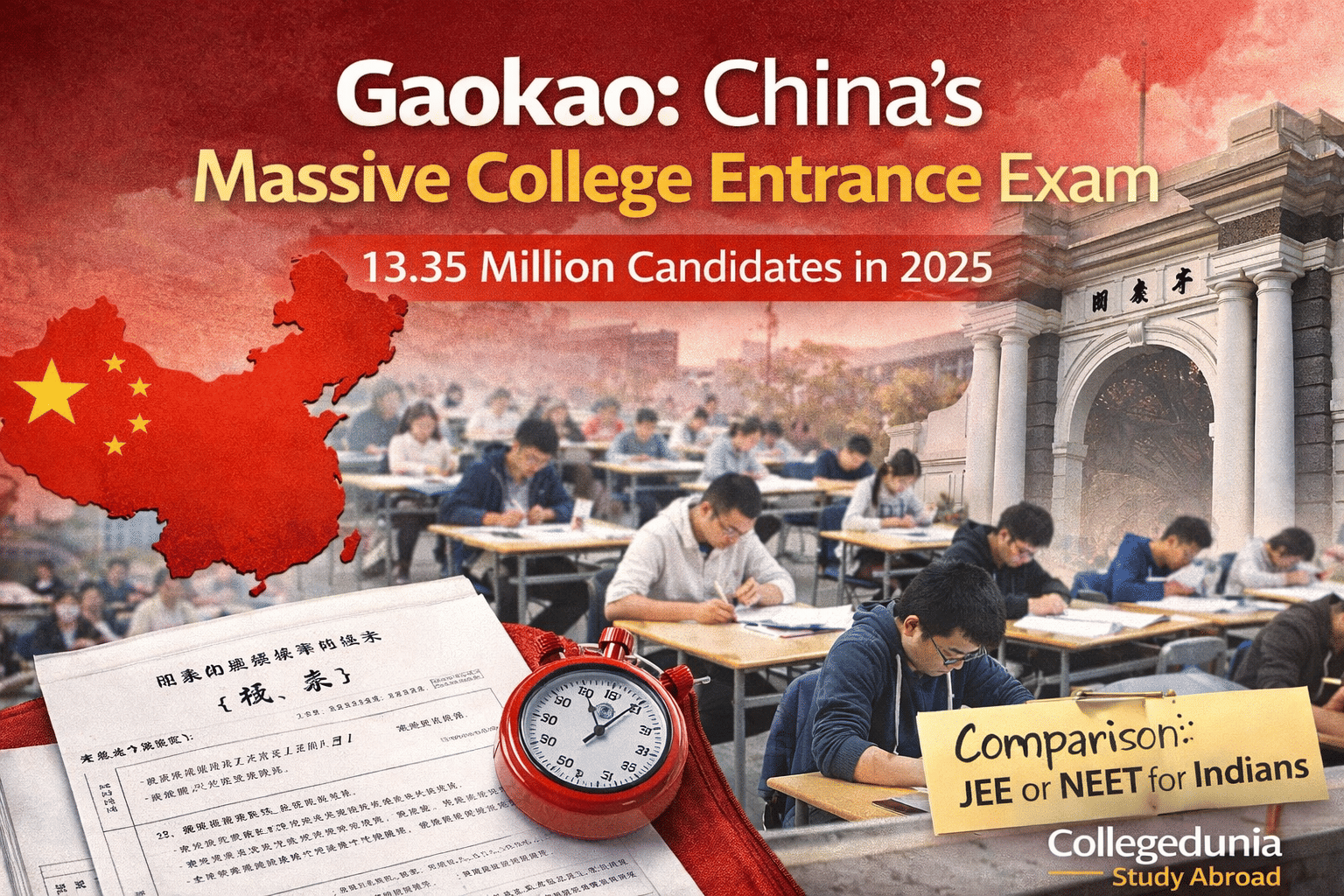
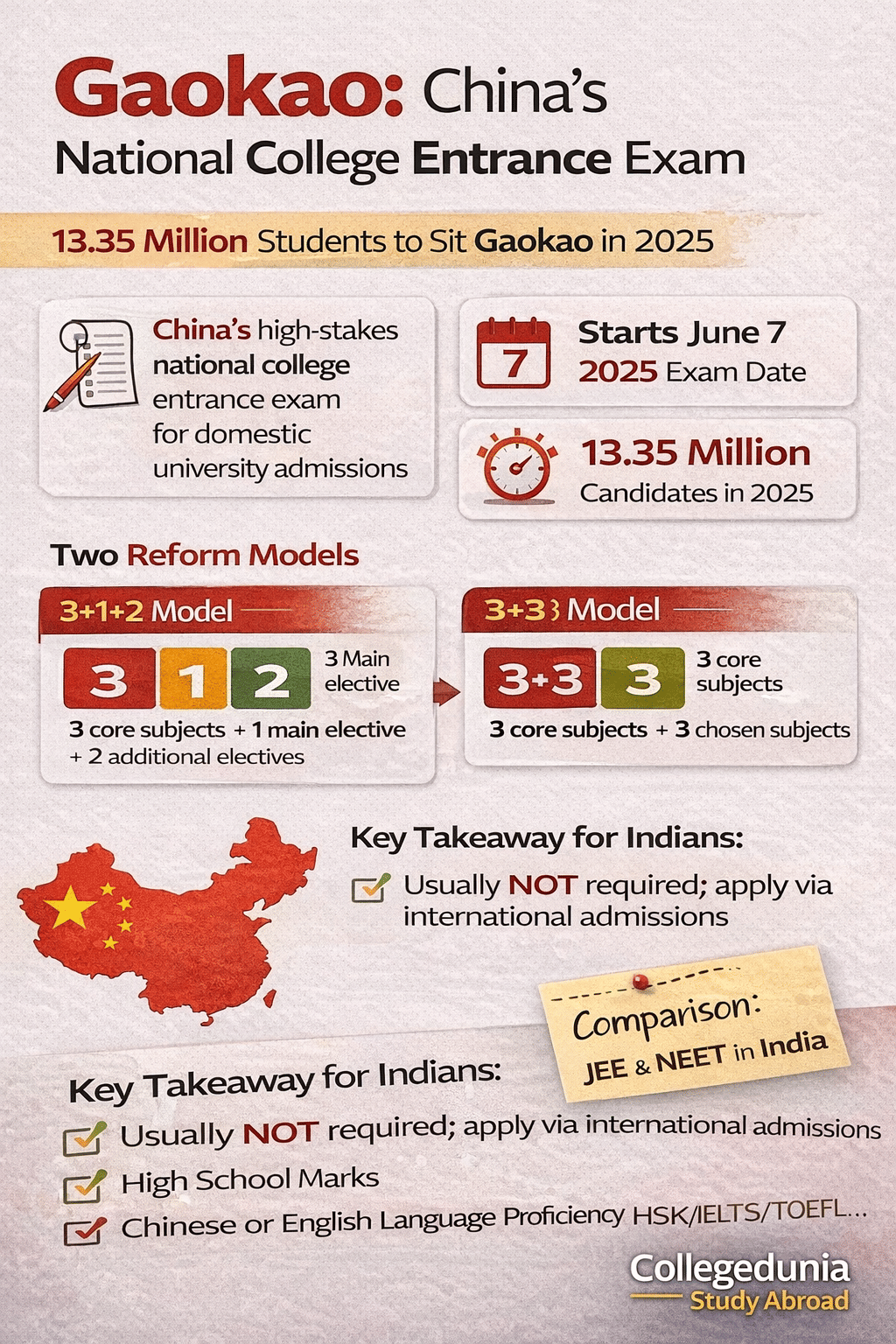
The Gaokao (高考) is China’s national college entrance examination and one of the most consequential exams in the country because it is a primary route into undergraduate education for domestic students. In 2025, China’s Ministry of Education stated that about 13.35 million students were set to sit the Gaokao, starting June 7, highlighting how large and competitive the system is. For Indian students, Gaokao is frequently searched due to comparisons with Indian entrance tests (like JEE/NEET) and questions about studying in China. However, most international applicants (including Indians) usually apply through separate international admissions pathways, not the domestic Gaokao track.
Check Out: Top 10 toughest exams in world
- What is the Gaokao exam in China?
- Is Gaokao the same across China?
- Gaokao exam pattern and subjects (core idea)
- Gaokao reforms explained: 3+3 vs 3+1+2 (new Gaokao)
- Gaokao scoring system
- How competitive is Gaokao? (numbers and trends)
- Gaokao vs JEE
- Do Indian students need Gaokao to study in China?
- FAQs
What is the Gaokao exam in China?
The Gaokao is China’s nationwide higher-education entrance exam, used primarily for domestic university admissions. It is widely viewed as high-stakes because performance can strongly influence the range of universities and programmes students can access. Official reporting for 2025 describes it as a major national event with extensive support and security arrangements.
A practical way to understand it is as a pipeline: exam → score → provincial cut-offs and allocation → university placement, with the details varying by region.
Is Gaokao the same across China?
Gaokao is nationally coordinated but not fully uniform across all provinces/regions. A commonly cited structural explanation is that administration and grading can be standardized within each province while varying across provinces, which is why “cut-offs” and score interpretation can differ by location.
At the policy level, China’s Ministry of Education (MOE) issues annual guidance aimed at maintaining fairness, exam security, and orderly admissions—indicating strong central oversight even when implementation differs locally.
| Aspect | Largely uniform / centrally guided | Often varies by province/region |
|---|---|---|
| Governance focus | MOE guidance on fairness, security, and admissions regulation | Local implementation intensity and operational details |
| Exam timing | National exam window typically around early June (e.g., starts June 7 in 2025) | Exam duration and subject scheduling can differ |
| Subject reform model | National reform direction exists | “3+1+2” and “3+3” coexist across regions |
| Scoring interpretation | Broad principle: merit-based selection | Scales, cut-off lines, and allocation mechanics vary |
Gaokao exam pattern and subjects (core idea)
Across models, there are typically core compulsory subjects (commonly described as Chinese, Mathematics, and a foreign language), alongside elective/choice components that depend on the reform model and the province.
Because provinces may follow different reform tracks, Indian readers should avoid assuming one “fixed” subject combination applies everywhere in China.
Gaokao reforms explained: 3+3 vs 3+1+2 (new Gaokao)
A key reason Gaokao is confusing in English coverage is the coexistence of two reform structures:
- “3+1+2” model (commonly described as three core subjects + one preferred subject + two additional subjects)
- “3+3” model (three core subjects + three chosen subjects)
China Daily reported that in the reformed system, “3+1+2” is used in 23 provinces and “3+3” remains in six locations, and that 29 provincial-level regions have adopted the reformed system, covering the vast majority of candidates.
| Feature | 3+3 model | 3+1+2 model |
|---|---|---|
| How choices work (high level) | More flexibility across three chosen subjects | Structured choice: one “main” subject + two additional |
| Where used | Reported in select regions | Reported as more widely used |
| Why it matters for admissions | Subject selection links to programme eligibility | Subject selection links to programme eligibility |
| Key caution for readers | Exact subject lists and rules vary by province | Exact subject lists and rules vary by province |
Gaokao scoring system
Students and parents often talk about “cut-offs,” but unlike many Indian exams where you might focus on an all-India rank/score logic, Gaokao outcomes are strongly shaped by provincial cut-off lines and allocation rules.
A safe way to interpret this (especially for Indian readers) is:
- A Gaokao score is meaningful within the province’s system
- University and programme eligibility depends on local cut-offs, preferences, and quotas that can differ by region
This is one reason comparison content that uses a single “national cut-off” framing is often misleading.
Gaokao timeline: registration to results to admissions
While the fine details vary, most descriptions follow a broad annual rhythm: registration → exam (early June) → score release → preference filling and admissions.
How competitive is Gaokao?
Scale is one of the clearest signals of competitiveness. Official Chinese government reporting cited 13.35 million candidates for the 2025 Gaokao.
Beyond scale, competitiveness is also shaped by:
- The number of seats in top universities relative to demand
- Provincial differences in cut-offs and allocation
- Policy focus on fairness/security, which aims to protect the credibility of outcomes
Gaokao vs JEE
Indian students often compare Gaokao to JEE because both are high-stakes and linked to life outcomes. The more useful comparison is about structure and admission mechanics, not “which is tougher.”
| Dimension | Gaokao (China) | JEE (India) |
|---|---|---|
| Primary role | Major route into undergraduate universities for domestic students | Major route into engineering admissions (IITs/NITs etc.) |
| Administration structure | Nationally guided, but implemented with provincial variation | National exam with standardised pattern across India |
| Subject model | Reform models (e.g., “3+3” and “3+1+2”) coexist | Fixed subject focus (Physics/Chemistry/Math for JEE) |
| Outcome mechanism | Score + provincial cut-offs + preferences/allocations | Score/rank + counselling + institute cut-offs |
| Common misconception | That it is “one uniform exam nationwide” | That coaching alone guarantees selection |
Note: JEE facts are general context; students should check the official JEE portal for exact current rules.
Do Indian students need Gaokao to study in China?
For most Indian students, the practical answer is no—because Indians generally apply as international students to Chinese universities through separate pathways.
For example, Tsinghua University’s international undergraduate eligibility is framed around being a foreign citizen with a high school graduation credential and showing academic performance through items such as transcripts and “results of international standard tests (e.g., SAT/ACT/A-Level/AP/IB…)” rather than stating Gaokao as the standard route for foreign applicants.
If you’re an Indian student, what you typically need instead of Gaokao
| Your goal in China | Typical pathway (high level) | Common evidence universities ask for (examples) | Where to verify |
|---|---|---|---|
| Undergraduate in China (as an international student) | International admissions route | School transcripts + recognised test results/credentials (university-specific) | Your target university’s international admissions page |
| Chinese-taught Master’s/PhD (scholarship or direct) | University admission + language requirement | HSK Level 4 is explicitly referenced in official scholarship/THU graduate admissions materials for Chinese-taught master’s/doctoral study | Embassy scholarship notice + university graduate admissions page |
| English-taught programmes | International admissions route | Often IELTS/TOEFL (programme-specific) | Target programme page (varies by university) |
Gaokao is best understood as China’s high-stakes domestic university entrance system operating at massive scale—13.35 million candidates in 2025—with strong central policy oversight but meaningful provincial variation in implementation and reform models. For Indian students, the most important takeaway is that Gaokao is usually not the route you will use to study in China; instead, you should shortlist universities and follow their international admissions rules, plus the relevant language requirements (HSK for Chinese-taught routes where stated).
FAQs
Ques. What is Gaokao in China?
Ans. Gaokao is China’s national college entrance examination and a major route into undergraduate admissions for domestic students. In 2025, China’s Ministry of Education reported about 13.35 million candidates were expected to sit the exam starting June 7.
Ques. Is Gaokao compulsory for studying in a Chinese university?
Ans. For domestic admissions, Gaokao is central. For international applicants (including Indian students), universities commonly use separate international admissions routes, such as those listed in Tsinghua’s international undergraduate eligibility framework.
Ques. How is Gaokao different from JEE in India?
Ans. Gaokao is a broad college entrance system shaped by provincial implementation and allocation mechanisms, while JEE is a national engineering entrance test with a more uniform national pattern. Gaokao’s reforms and regional differences (e.g., “3+3” vs “3+1+2”) are a key structural distinction.
Ques. What do Indian students need instead of Gaokao to study in China?
Ans. Most Indian students apply via international admissions and must meet the university’s academic and language requirements. For Chinese-taught master’s/doctoral routes, official scholarship/university materials commonly reference HSK Level 4 as a Chinese proficiency baseline.
1777688158.png?tr=w-305,h-145,c-force?h=40&w=40&mode=stretch)



Comments