




Maharashtra Board conducted the Class 10 Science and Technology Board Paper 2026 on March 11, 2026. Students can analyse their performance as SSC Board Science and Technology Question Paper 2026 with Solution PDF is available here for download.
The Maharashtra SSC Board Class 10 Science and Technology paper covered key topics from physics, chemistry, biology, and technology. The question paper of Maharashtra SSC Board Class 10 Science and Technology Board Exam 2026 is provided below.
Maharashtra Board Class 10 2026 Science and Technology Question Paper with Solution PDF
| Maharashtra Board Class 10 Science and Technology Question Paper 2026 | Download PDF | Check Solution |
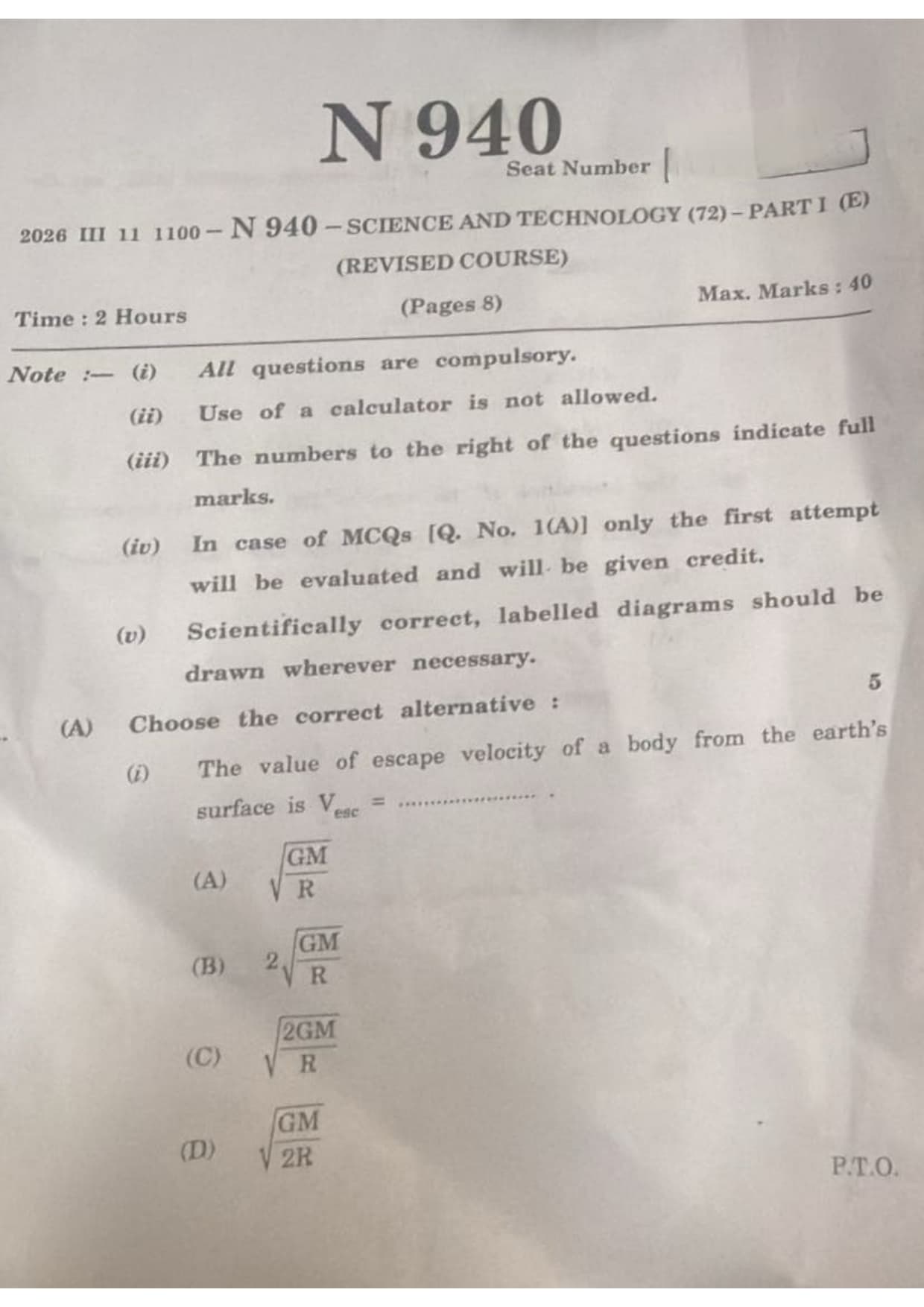
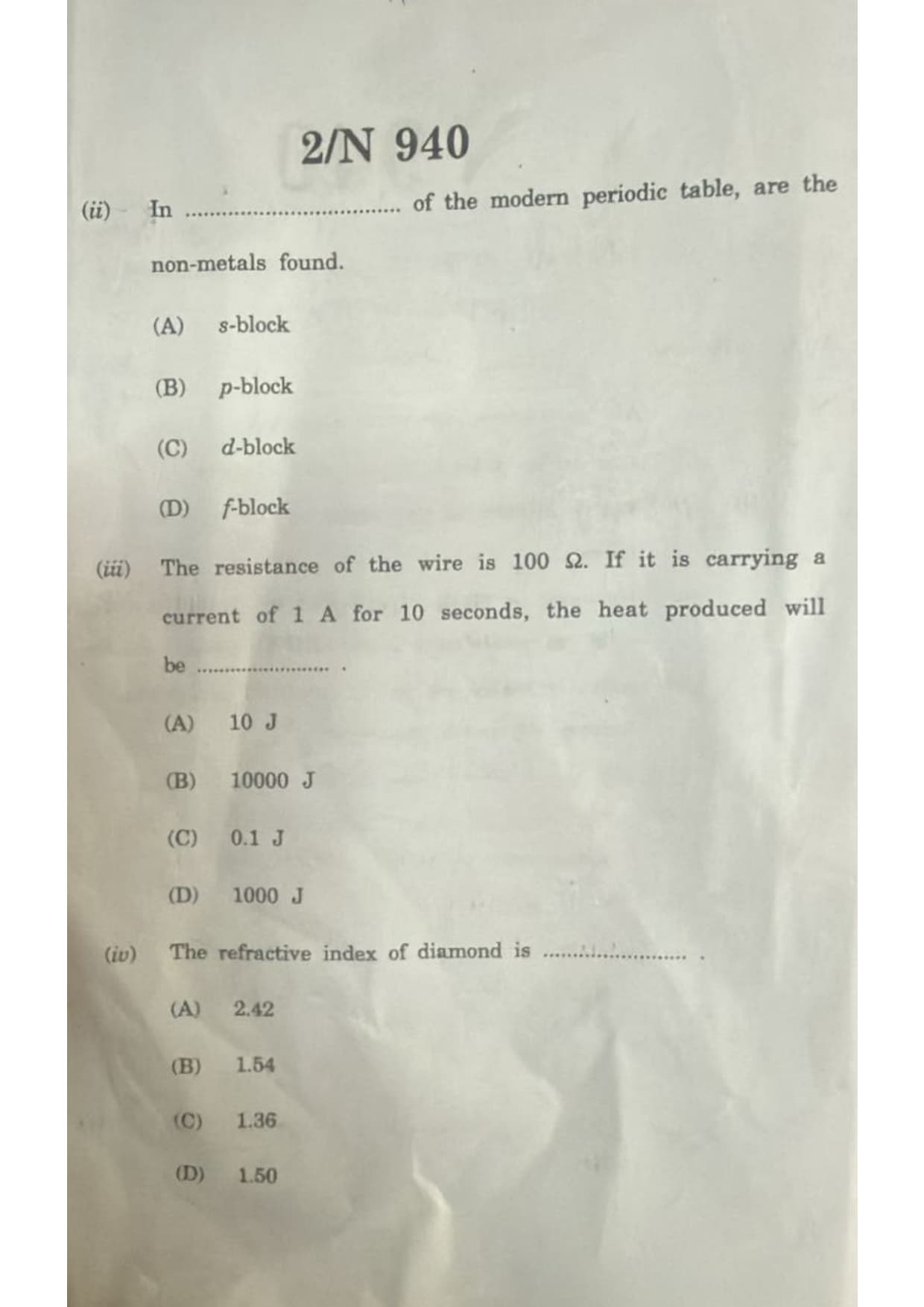
The value of escape velocity of a body from the Earth's surface is \( V_{esc} = \dots \)
View Solution
Step 1: Understanding escape velocity.
The escape velocity is the minimum speed an object must have to escape the gravitational pull of the Earth (or any celestial body) without any additional propulsion. The formula for escape velocity is derived from the law of conservation of energy.
Step 2: Escape velocity formula.
The formula for escape velocity from the Earth's surface is given by: \[ V_{esc} = \sqrt{\frac{2GM}{R}} \]
Where:
- \( G \) is the gravitational constant,
- \( M \) is the mass of the Earth,
- \( R \) is the radius of the Earth.
Step 3: Identifying the correct option.
(A) \( \sqrt{\frac{GM}{R}} \): Incorrect. This is not the correct formula for escape velocity.
(B) \( 2\sqrt{\frac{GM}{R}} \): Incorrect. This formula does not represent the escape velocity.
(C) \( \sqrt{\frac{2GM}{R}} \): Correct. This is the correct formula for escape velocity.
(D) \( \sqrt{\frac{GM}{2R}} \): Incorrect. This does not represent escape velocity either.
Step 4: Conclusion.
Thus, the correct value of the escape velocity is \( \sqrt{\frac{2GM}{R}} \), as given in option (C).
Final Answer: (C) \( \sqrt{\frac{2GM}{R}} \).
Quick Tip: The escape velocity depends on the mass of the Earth and the distance from the center of the Earth (or the celestial body).
In ______ of the modern periodic table, are the non-metals found.
View Solution
Step 1: Understanding the periodic table.
The modern periodic table organizes elements into blocks: s-block, p-block, d-block, and f-block. The non-metals are mostly found in the p-block of the periodic table.
Step 2: Analyzing the options.
(A) s-block: Incorrect. The s-block elements are metals, and non-metals are not typically found here.
(B) p-block: Correct. The p-block elements include most non-metals such as oxygen, nitrogen, and halogens.
(C) d-block: Incorrect. The d-block elements are transition metals, which are mostly metallic.
(D) f-block: Incorrect. The f-block consists of lanthanides and actinides, which are metals.
Step 3: Conclusion.
Therefore, the correct answer is (B) p-block, where the non-metals are found.
Final Answer: p-block. Quick Tip: Non-metals are predominantly found in the p-block of the periodic table, while metals occupy the s, d, and f blocks.
The resistance of the wire is 100 \(\Omega\). If it is carrying a current of 1 A for 10 seconds, the heat produced will be ______.
View Solution
Step 1: Using the formula for electrical heat.
The heat produced in a resistor is given by the formula: \[ H = I^2 \times R \times t \]
where \( I \) is the current, \( R \) is the resistance, and \( t \) is the time.
Step 2: Substituting the values.
Given:
- \( I = 1 \, A \)
- \( R = 100 \, \Omega \)
- \( t = 10 \, seconds \)
The heat produced is: \[ H = (1)^2 \times 100 \times 10 = 1000 \, J. \]
Step 3: Conclusion.
Thus, the heat produced is 1000 J, so the correct answer is (D).
Final Answer: 1000 J. Quick Tip: The formula for calculating heat produced by a resistor is \( H = I^2 \times R \times t \), where \( I \) is current, \( R \) is resistance, and \( t \) is time.
The refractive index of diamond is _______ .
View Solution
Step 1: Understanding refractive index.
The refractive index (or index of refraction) of a material is a measure of how much light slows down as it passes through the material compared to its speed in a vacuum. The refractive index is given by the ratio of the speed of light in vacuum to the speed of light in the material.
Step 2: Refractive index of diamond.
For diamond, the refractive index is known to be approximately 2.42, which means that light travels slower in diamond than in air or vacuum.
Step 3: Identifying the correct option.
(A) 2.42: Correct. The refractive index of diamond is 2.42.
(B) 1.54: Incorrect. This value corresponds to glass, not diamond.
(C) 1.36: Incorrect. This refractive index is lower and doesn't correspond to diamond.
(D) 1.50: Incorrect. This is the refractive index of water or glass, not diamond.
Step 4: Conclusion.
Thus, the correct refractive index of diamond is 2.42.
Final Answer: (A) 2.42.
Quick Tip: The refractive index of diamond is high due to its dense atomic structure, causing light to slow down significantly.
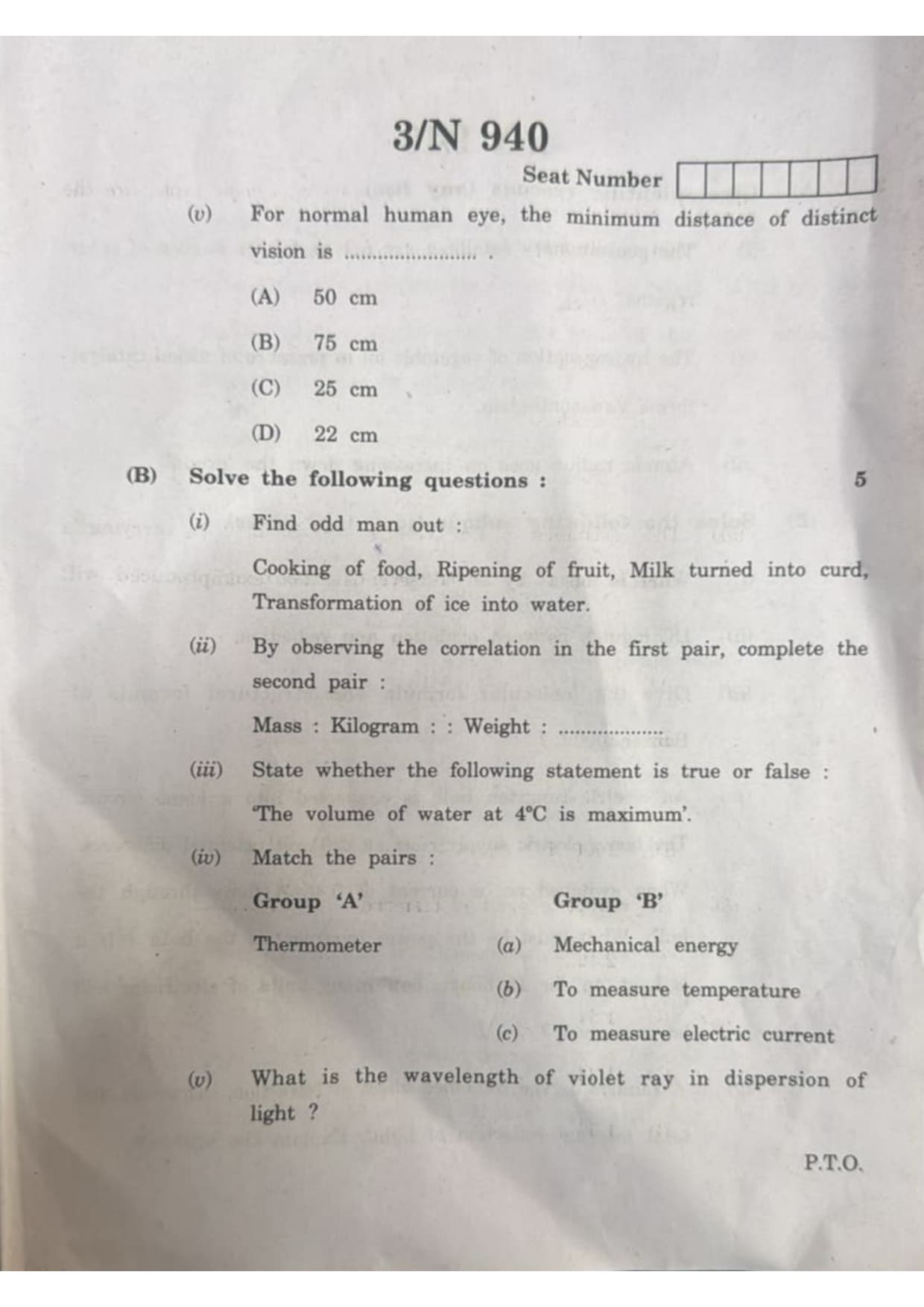
For normal human eye, the minimum distance of distinct vision is _______ .
View Solution
Step 1: Understanding the minimum distance of distinct vision.
The minimum distance of distinct vision, also known as the near point, is the closest distance at which the human eye can focus on an object clearly. For a normal human eye, this distance is typically 25 cm.
Step 2: Evaluating the options.
(A) 50 cm: Incorrect. This is not the typical minimum distance for distinct vision.
(B) 75 cm: Incorrect. This is too large compared to the normal near point distance.
(C) 25 cm: Correct. The normal minimum distance for clear vision for a human eye is approximately 25 cm.
(D) 22 cm: Incorrect. While this could be the case for some individuals, 25 cm is the average minimum distance for most people.
Step 3: Conclusion.
Thus, the correct answer is 25 cm, which is the typical near point of a normal human eye.
Final Answer: (C) 25 cm.
Quick Tip: The minimum distance of distinct vision is 25 cm for a normal human eye. This is the near point, and it can vary slightly with age and individual differences.
Find the odd man out:
Cooking of food, Ripening of fruit, Milk turned into curd, Transformation of ice into water.
View Solution
Step 1: Analyzing the options.
- Cooking of food: A process where heat is applied to raw food to make it edible.
- Ripening of fruit: A natural process where a fruit matures and changes color.
- Milk turned into curd: A process of fermentation where milk turns into curd by adding a
starter culture.
- Transformation of ice into water: A physical change where solid ice melts into liquid
water.
Step 2: Odd one out.
The odd one out is Transformation of ice into water as it is a physical change, while the
others are chemical or biological processes.
Quick Tip: Remember: Physical changes like the melting of ice don't form a new substance, while chemical and biological processes like cooking, ripening, and fermentation do.
By observing the correlation in the first pair, complete the second pair:
Mass : Kilogram : : Weight : ?
View Solution
Step 1: Analyzing the first pair.
In the first pair, Mass is measured in Kilogram, which is a unit of measurement for mass.
Step 2: Completing the second pair.
For Weight, the corresponding unit of measurement is Newton, as weight is the force
exerted by gravity on an object, and it is measured in newtons. Quick Tip: Remember: Mass is measured in kilograms, while weight is measured in newtons.
State whether the following statement is true or false:
The volume of water at 4°C is maximum.
View Solution
Step 1: Concept of Maximum Density of Water.
Water reaches its maximum density at 4°C, meaning that its volume is minimum at this temperature. Therefore, the statement is false as the volume is not maximum at 4°C.
Step 2: Explanation.
At temperatures below 4°C, water begins to expand as it freezes into ice, which has a larger volume. So, 4°C is the point of maximum density (minimum volume). Quick Tip: Remember: The maximum density of water occurs at 4°C, and its volume is minimum at this temperature.
Match the pairs:

View Solution
To match the pairs, let’s analyze the instruments and their functions:
Step 1: Understanding the Thermometer.
A thermometer is an instrument designed specifically to measure temperature. It works by detecting the physical changes that occur in a material (such as the expansion of mercury or alcohol) as the temperature increases or decreases. The correct match for the thermometer is (b) To measure temperature.
Step 2: Analyzing the Other Options.
- Mechanical energy: Instruments used to measure mechanical energy include devices like spring scales or energy meters. These are not associated with a thermometer, so the match (a) Mechanical energy is not appropriate for the thermometer.
- To measure electric current: Instruments used to measure electric current include ammeters. These are not related to thermometers, so the match (c) To measure electric current is also incorrect for the thermometer.
Thus, the correct matching is:
- Thermometer \(\rightarrow\) (b) To measure temperature. Quick Tip: Remember: Thermometers are used to measure temperature, not mechanical energy or electric current.
What is the wavelength of violet ray in dispersion of light?
View Solution
Step 1: Explanation of Dispersion of Light.
Dispersion of light occurs when light passes through a medium, like a prism, and gets separated into its constituent colors. Each color has a different wavelength, which causes the light to spread out.
Step 2: Wavelength of Violet Ray.
The violet ray is the shortest wavelength in the visible spectrum of light. Its wavelength ranges from approximately 380 nm to 450 nm, with 400 nm being a commonly cited value.
Step 3: Conclusion.
Thus, the wavelength of the violet ray in dispersion of light is around 400 nm. This shorter wavelength causes violet light to refract more than other colors when passing through a prism. Quick Tip: Remember: Violet light has the shortest wavelength in the visible spectrum and refracts the most when passing through a prism.
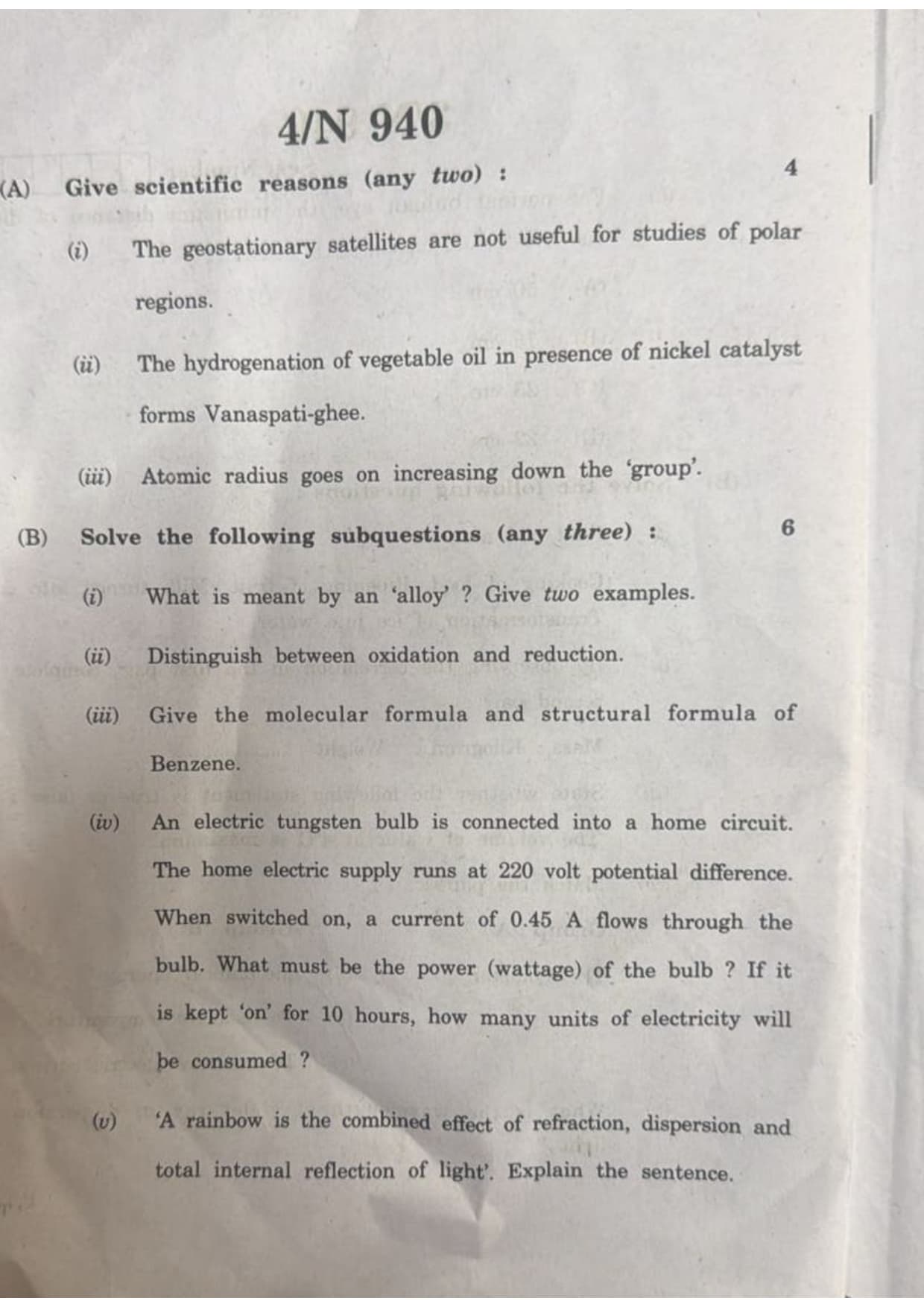
The geostationary satellites are not useful for studies of polar regions.
View Solution
Step 1: Understanding Geostationary Satellites.
Geostationary satellites are placed at a fixed point in the Earth's orbit, over the equator, at an altitude of about 35,786 km. These satellites orbit at the same speed as the Earth rotates, making them stationary relative to a point on the Earth’s surface.
Step 2: Why They Are Not Useful for Polar Regions.
Because geostationary satellites are positioned above the equator, they are unable to capture data from polar regions as they are always positioned at the same location relative to the Earth. Polar regions fall outside their coverage area.
Step 3: Alternative Satellite Options.
For polar regions, polar orbiting satellites are used as they can pass over the poles, providing complete coverage of the Earth's surface. Quick Tip: Remember: Geostationary satellites are ideal for equatorial regions, while polar orbiting satellites are better suited for studying the poles.
The hydrogenation of vegetable oil in the presence of nickel catalyst forms Vanaspati-ghee.
View Solution
Step 1: Process of Hydrogenation.
Hydrogenation is a chemical process where hydrogen is added to unsaturated fats (vegetable oil) in the presence of a catalyst (such as nickel) to convert them into saturated fats.
Step 2: Formation of Vanaspati.
Vanaspati is a type of hydrogenated vegetable oil that has a high melting point and is solid at room temperature. The hydrogenation process leads to the formation of Vanaspati, also known as "Vanaspati-ghee" in India.
Step 3: Use of Nickel Catalyst.
Nickel is used as a catalyst in the hydrogenation process because it accelerates the reaction without being consumed by it. Quick Tip: Remember: Hydrogenation of vegetable oil turns it into a solid fat (Vanaspati) with the help of a nickel catalyst.
Atomic radius goes on increasing down the 'group'.
View Solution
Step 1: Atomic Radius and Groups.
Atomic radius is defined as the distance from the nucleus of an atom to the outermost electron. As we move down a group in the periodic table, the number of electron shells increases.
Step 2: Explanation for Increasing Atomic Radius.
As the number of electron shells increases, the outermost electrons are farther from the nucleus. Although the nuclear charge increases, the effect of the added electron shells reduces the attractive force between the nucleus and the outer electrons, allowing the atomic radius to increase.
Step 3: Example.
For example, the atomic radius increases from lithium (Li) to cesium (Cs) as we move down Group 1 of the periodic table. Quick Tip: Remember: Atomic radius increases as we move down a group due to the addition of electron shells and reduced nuclear attraction.
What is meant by an 'alloy'? Give two examples.
View Solution
Step 1: Definition of Alloy.
An alloy is a mixture of two or more elements, where at least one element is a metal. Alloys are created to enhance the properties of the base metal, such as strength, durability, or resistance to corrosion.
Step 2: Examples of Alloys.
Two examples of alloys are:
1. Steel: An alloy of iron and carbon, used in construction and machinery due to its strength.
2. Bronze: An alloy of copper and tin, used in making sculptures and coins due to its corrosion resistance. Quick Tip: Remember: An alloy is a combination of metals or a metal with another element to improve its properties.
Distinguish between oxidation and reduction.
View Solution
Step 1: Definition of Oxidation.
Oxidation refers to the process where an element or compound loses electrons. This leads to an increase in the oxidation state of the element. For example, when iron reacts with oxygen, it forms iron oxide (rust), with iron losing electrons.
Step 2: Definition of Reduction.
Reduction is the process where an element or compound gains electrons, leading to a decrease in its oxidation state. For example, in the reaction between copper(II) oxide and hydrogen, copper gains electrons and is reduced to copper metal.
Step 3: Key Difference.
- Oxidation is the loss of electrons and an increase in oxidation state.
- Reduction is the gain of electrons and a decrease in oxidation state. Quick Tip: Remember: Oxidation involves electron loss (increase in oxidation state), while reduction involves electron gain (decrease in oxidation state).
Give the molecular formula and structural formula of Benzene.
View Solution
Step 1: Molecular Formula of Benzene.
The molecular formula of benzene is \( C_6H_6 \), indicating that it contains six carbon atoms and six hydrogen atoms.
Step 2: Structural Formula of Benzene.
The structural formula of benzene is represented as a six-membered carbon ring with alternating single and double bonds between the carbon atoms. The structure can be represented as follows:
\[ C_6H_6: \quad C = C - C = C - C = C - C = C \]
Where the double bonds alternate between the carbon atoms, forming a cyclic structure. Quick Tip: Remember: Benzene has a molecular formula of \( C_6H_6 \) and a hexagonal ring structure with alternating single and double bonds between carbon atoms.
An electric tungsten bulb is connected into a home circuit. The home electric supply runs at 220 volt potential difference. When switched on, a current of 0.45 A flows through the bulb. What must be the power (wattage) of the bulb? If it is kept ‘on’ for 10 hours, how many units of electricity will be consumed?
View Solution
Step 1: Power (Wattage) of the Bulb.
The power consumed by an electrical device can be calculated using the formula: \[ P = V \times I \]
Where:
- \(P\) is the power in watts,
- \(V\) is the voltage in volts,
- \(I\) is the current in amperes.
Given that the voltage \(V = 220\) volts and the current \(I = 0.45\) A, we can calculate the power: \[ P = 220 \, V \times 0.45 \, A = 99 \, W \]
Thus, the power of the bulb is 99 watts.
Step 2: Units of Electricity Consumed.
To find the units of electricity consumed, we use the formula for energy: \[ E = P \times t \]
Where:
- \(E\) is the energy consumed in watt-hours (Wh),
- \(P\) is the power in watts,
- \(t\) is the time in hours.
The time is given as \(t = 10\) hours, and the power is \(P = 99\) watts. Therefore, the energy consumed is: \[ E = 99 \, W \times 10 \, h = 990 \, Wh \]
Now, 1 unit of electricity is equal to 1 kilowatt-hour (kWh), so we convert watt-hours to kilowatt-hours: \[ Energy in units = \frac{990 \, Wh}{1000} = 0.99 \, kWh \]
Thus, the electricity consumed in 10 hours is 0.99 units.
Quick Tip: Remember: Power is calculated as \(P = V \times I\), and energy is \(E = P \times t\). 1 unit of electricity = 1 kWh.
‘A rainbow is the combined effect of refraction, dispersion, and total internal reflection of light’. Explain the sentence.
View Solution
Step 1: Refraction of Light.
Refraction occurs when light passes from one medium to another and bends due to the change in speed. In a rainbow, light refracts as it enters the water droplets in the atmosphere.
Step 2: Dispersion of Light.
Dispersion is the separation of light into its different colors (spectrum) based on their wavelengths. In the case of a rainbow, different colors of light refract at different angles, creating the spectrum of colors we see.
Step 3: Total Internal Reflection.
Total internal reflection occurs when light hits the inside surface of a medium at a steep angle and reflects back into the medium instead of passing through. Inside the water droplets, the light undergoes total internal reflection, which directs the light towards our eyes.
Step 4: The Formation of a Rainbow.
As sunlight enters a water droplet, it first refracts, then disperses into its constituent colors, and finally undergoes total internal reflection. The light then exits the droplet and refracts again as it leaves, creating a rainbow.
Thus, a rainbow is formed by the combined effect of refraction, dispersion, and total internal reflection of light.
Quick Tip: Remember: A rainbow forms when light undergoes refraction, dispersion, and total internal reflection inside water droplets.
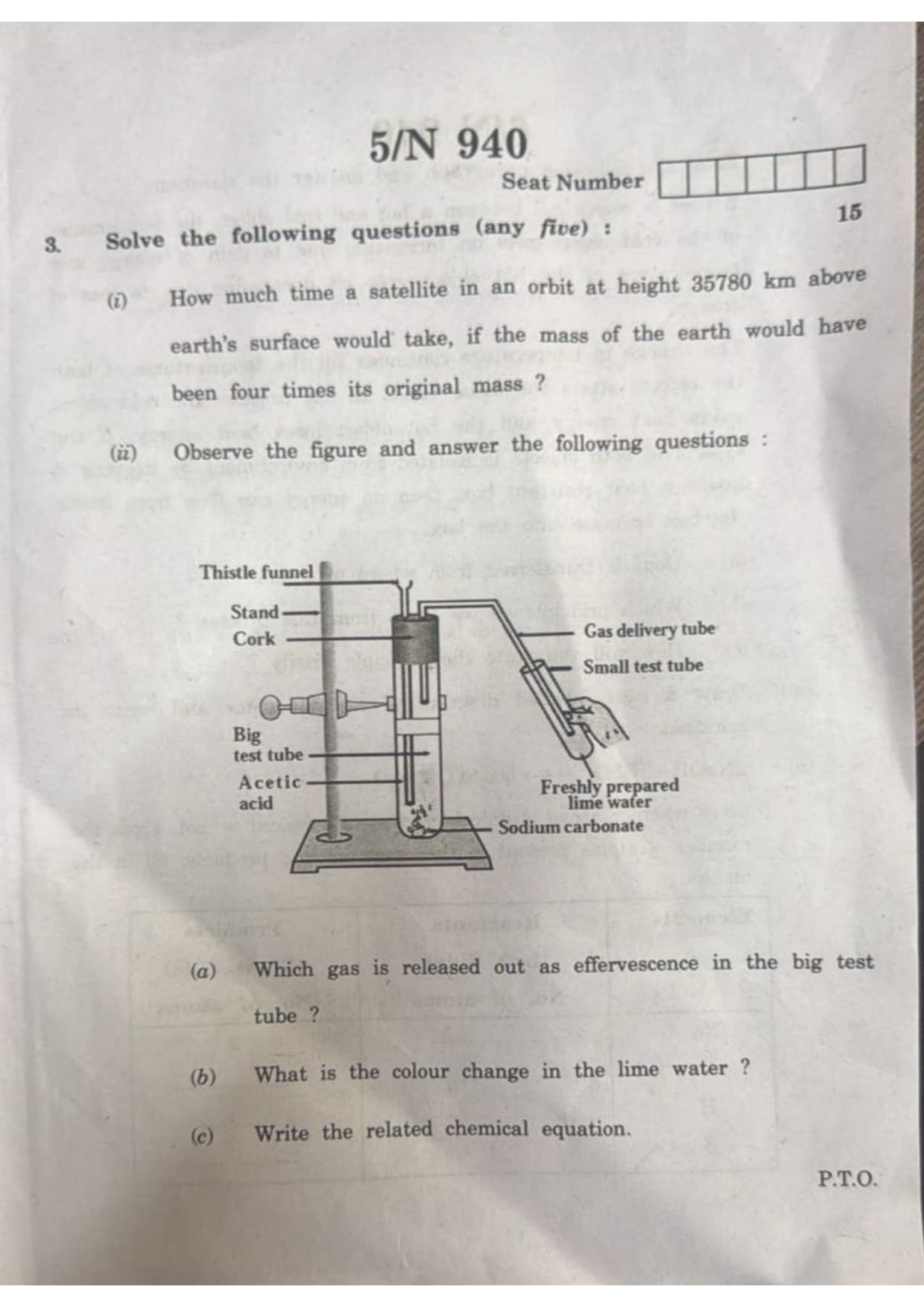
How much time a satellite in an orbit at height 35780 km above earth's surface would take, if the mass of the earth would have been four times its original mass?
View Solution
Step 1: Orbital Time Formula.
The time period \(T\) of a satellite in orbit is given by the formula: \[ T = 2 \pi \sqrt{\frac{r^3}{GM}} \]
Where:
- \(T\) is the orbital time period,
- \(r\) is the distance from the center of the earth,
- \(G\) is the universal gravitational constant,
- \(M\) is the mass of the earth.
Given that the height of the satellite above the earth’s surface is \(35780\) km, the total distance from the center of the earth is: \[ r = 35780 \, km + 6371 \, km = 42151 \, km = 4.2151 \times 10^7 \, m \]
Step 2: Impact of Changing Earth’s Mass.
If the mass of the earth is increased by a factor of 4, the new mass \(M'\) becomes: \[ M' = 4M \]
Step 3: New Time Period.
Substituting the new mass into the orbital time formula, we get: \[ T' = 2 \pi \sqrt{\frac{r^3}{G \times 4M}} = \frac{T}{2} \]
Thus, the new orbital time period will be half of the original time period, i.e., the satellite will complete its orbit in half the time.
Quick Tip: Remember: The orbital time period is inversely proportional to the square root of the mass of the central body. Increasing the mass of the earth reduces the time period.
Observe the figure and answer the following questions:

(a) Which gas is released as effervescence in the big test tube?
(b) What is the colour change in the lime water?
(c) Write the related chemical equation.
View Solution
Step 1: Identify the Gas Released.
In the figure, sodium carbonate reacts with acetic acid to produce carbon dioxide gas. This gas is released as effervescence in the big test tube.
Step 2: Name of the Gas.
The gas released is carbon dioxide (CO2). This gas is produced due to the reaction between acetic acid and sodium carbonate.
(a))
The gas released is carbon dioxide (CO2). The effervescence observed is due to the formation of carbon dioxide gas as sodium carbonate reacts with acetic acid.
(b)
When carbon dioxide gas (CO2) passes through freshly prepared lime water (calcium hydroxide solution), it forms calcium carbonate, which is insoluble and precipitates out, turning the lime water milky.
Step 1: Chemical Reaction.
The reaction is as follows: \[ Ca(OH)_2 (aq) + CO_2 (g) \rightarrow CaCO_3 (s) + H_2O (l) \]
The lime water turns milky due to the formation of calcium carbonate.
(c)
The chemical equation for the reaction between sodium carbonate and acetic acid is:
\[ Na_2CO_3 (aq) + 2CH_3COOH (aq) \rightarrow 2CH_3COONa (aq) + CO_2 (g) + H_2O (l) \]
This equation shows the production of carbon dioxide gas (CO2), which is released as effervescence. Quick Tip: Remember: Carbon dioxide gas is produced when an acid reacts with a carbonate.
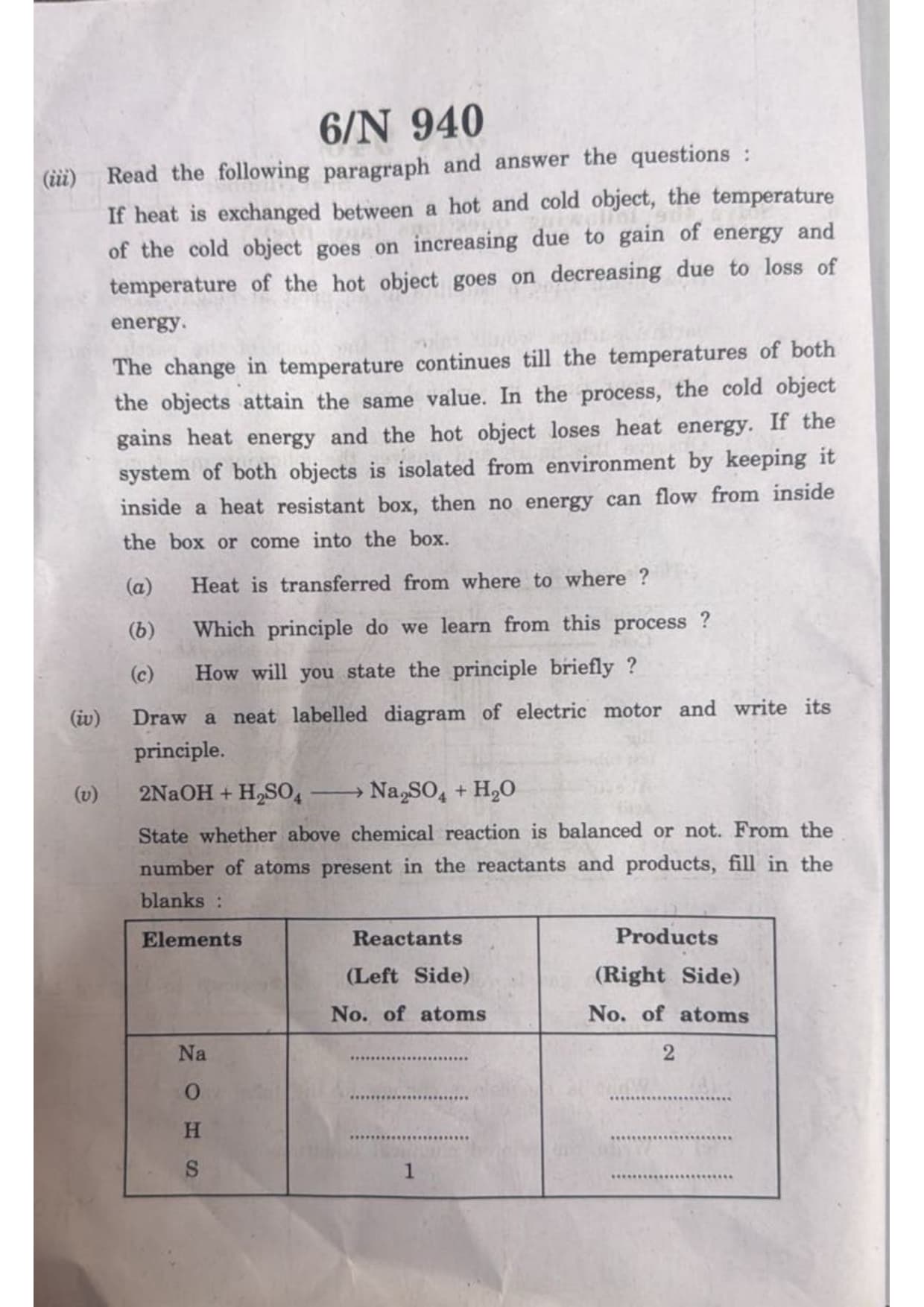
Heat is transferred from where to where?
View Solution
Step 1: Understanding Heat Transfer.
Heat is transferred from the region of higher temperature to the region of lower temperature. This is a fundamental principle of heat transfer.
Step 2: Explanation.
When two objects with different temperatures come in contact, heat will always flow from the hotter object to the cooler object until thermal equilibrium is reached. Quick Tip: Remember: Heat always flows from the hot body to the cold body.
Which principle do we learn from this process?
View Solution
Step 1: Principle of Heat Transfer.
The principle we learn from this process is the Second Law of Thermodynamics, which states that heat flows from a body at higher temperature to a body at lower temperature.
Step 2: Explanation.
This law implies that spontaneous processes naturally lead to an increase in entropy, or disorder, in a system. The heat transfer follows this principle, as energy naturally moves from hotter to cooler regions. Quick Tip: Remember: The Second Law of Thermodynamics governs the direction of heat transfer.
How will you state the principle briefly?
View Solution
Step 1: Brief Statement of the Principle.
The principle can be briefly stated as: "Heat flows from a body at higher temperature to a body at lower temperature."
Step 2: Explanation.
This statement is a concise representation of the Second Law of Thermodynamics, which governs the direction of heat transfer in natural processes. Quick Tip: Remember: The principle is simply "Heat flows from hot to cold."
State whether the above chemical reaction is balanced or not. From the number of atoms present in the reactants and products, fill in the blanks:
View Solution
The chemical equation is given as: \[ 2NaOH + H_2SO_4 \rightarrow Na_2SO_4 + H_2O \]
We need to check whether this reaction is balanced by comparing the number of atoms of each element on both sides.
Step 1: Elements on the left side (reactants).
- Sodium (Na): 2 atoms (from 2 NaOH)
- Oxygen (O): 2 atoms (from 2 NaOH) + 4 atoms (from H2SO4) = 6 atoms
- Hydrogen (H): 2 atoms (from NaOH) + 2 atoms (from H2SO4) = 4 atoms
- Sulfur (S): 1 atom (from H2SO4)
Step 2: Elements on the right side (products).
- Sodium (Na): 2 atoms (from Na2SO4)
- Oxygen (O): 4 atoms (from Na2SO4) + 1 atom (from H2O) = 5 atoms
- Hydrogen (H): 2 atoms (from H2O)
- Sulfur (S): 1 atom (from Na2SO4)
Step 3: Balance check.
We can see that the number of oxygen and hydrogen atoms is not the same on both sides. The equation is not balanced. Quick Tip: Remember: In a balanced chemical reaction, the number of atoms of each element should be the same on both sides of the equation.
Draw a neat labelled diagram of electric motor and write its principle.

View Solution
Step 1: Principle of Electric Motor.
The electric motor works on the principle of the force experienced by a current-carrying conductor placed in a magnetic field. When a current-carrying conductor is placed in a magnetic field, it experiences a force which tends to move the conductor. The direction of the force is given by Fleming’s Left-Hand Rule, which states that when the thumb, forefinger, and middle finger of the left hand are held at right angles, the thumb points in the direction of motion (force), the forefinger points in the direction of magnetic field, and the middle finger points in the direction of current.
Step 2: Labeled Diagram of Electric Motor.
A labeled diagram of an electric motor is shown below: Quick Tip: Remember: The principle of an electric motor is based on the interaction of magnetic fields and electric current which generates motion.
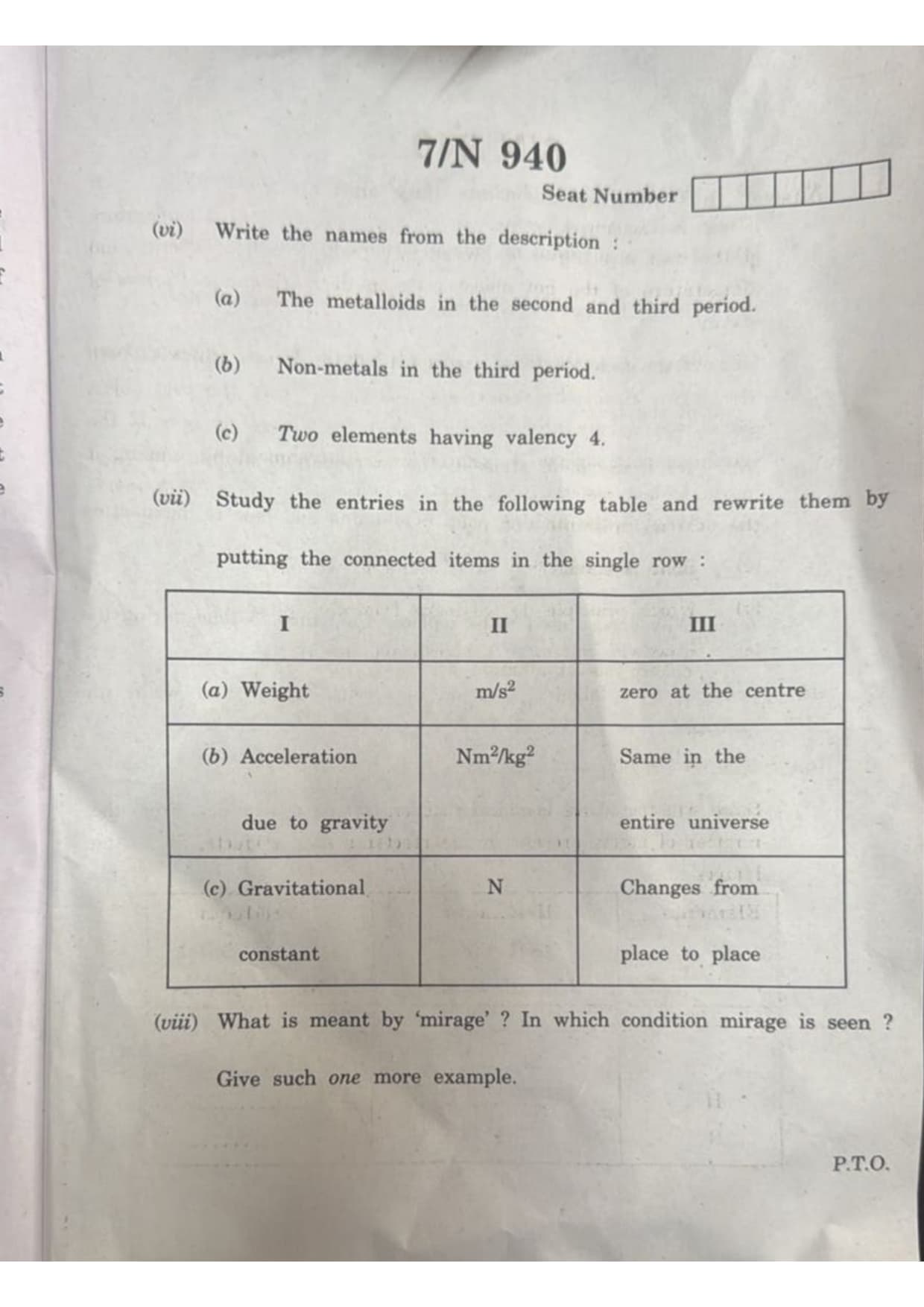
Write the names from the description:
View Solution
(a) The metalloids in the second and third periods.
The metalloids in the second and third periods are:
- Second period: Boron (B)
- Third period: Silicon (Si), Germanium (Ge)
(b) Non-metals in the third period.
The non-metals in the third period are:
- Third period: Oxygen (O), Nitrogen (N), and Chlorine (Cl)
(c) Two elements having valency 4.
Two elements having a valency of 4 are:
- Carbon (C): It has a valency of 4 because it can form four bonds in compounds like methane (CH4).
- Silicon (Si): It also has a valency of 4 because it can form four bonds in compounds like silicon dioxide (SiO2). Quick Tip: Remember: Metalloids have properties intermediate between metals and non-metals, and elements with valency 4 often form covalent bonds.
Study the entries in the following table and rewrite them by putting the connected items in the single row:

View Solution
Step 1: Rewriting the connected items in a single row.
- (a) Weight: The unit of weight is \( m/s^2 \) and it is zero at the centre.
- (b) Acceleration due to gravity: Its unit is \( Nm^2/kg^2 \), and it is same in the entire universe.
- (c) Gravitational constant: Its unit is \( N \), and it changes from place to place. Quick Tip: Remember: Weight depends on the gravitational pull, and the acceleration due to gravity is constant in the universe, while the gravitational constant varies with location.
What is meant by ‘mirage’? In which condition mirage is seen?
View Solution
A mirage is an optical illusion that occurs due to the refraction of light rays. It is a phenomenon where light is bent due to the difference in temperature between the ground and the air above it, creating the illusion of water or distant objects that aren't really there.
Step 1: Condition for Mirage Formation.
A mirage is typically seen in hot conditions when the ground is heated by the sun, causing the air close to the ground to be much warmer than the air above it. This temperature gradient causes light rays to bend, and when they reach our eyes, they appear to come from a different location, creating an illusion of water or objects.
Step 2: Example of Mirage.
One common example is when driving on a hot road in a desert, the road appears to be covered in water, even though there is no water present. This is a mirage caused by the hot air and ground temperature differences. Quick Tip: Remember: A mirage is caused by the refraction of light due to varying air temperatures, and it is often seen on hot days with heated surfaces like roads or deserts.
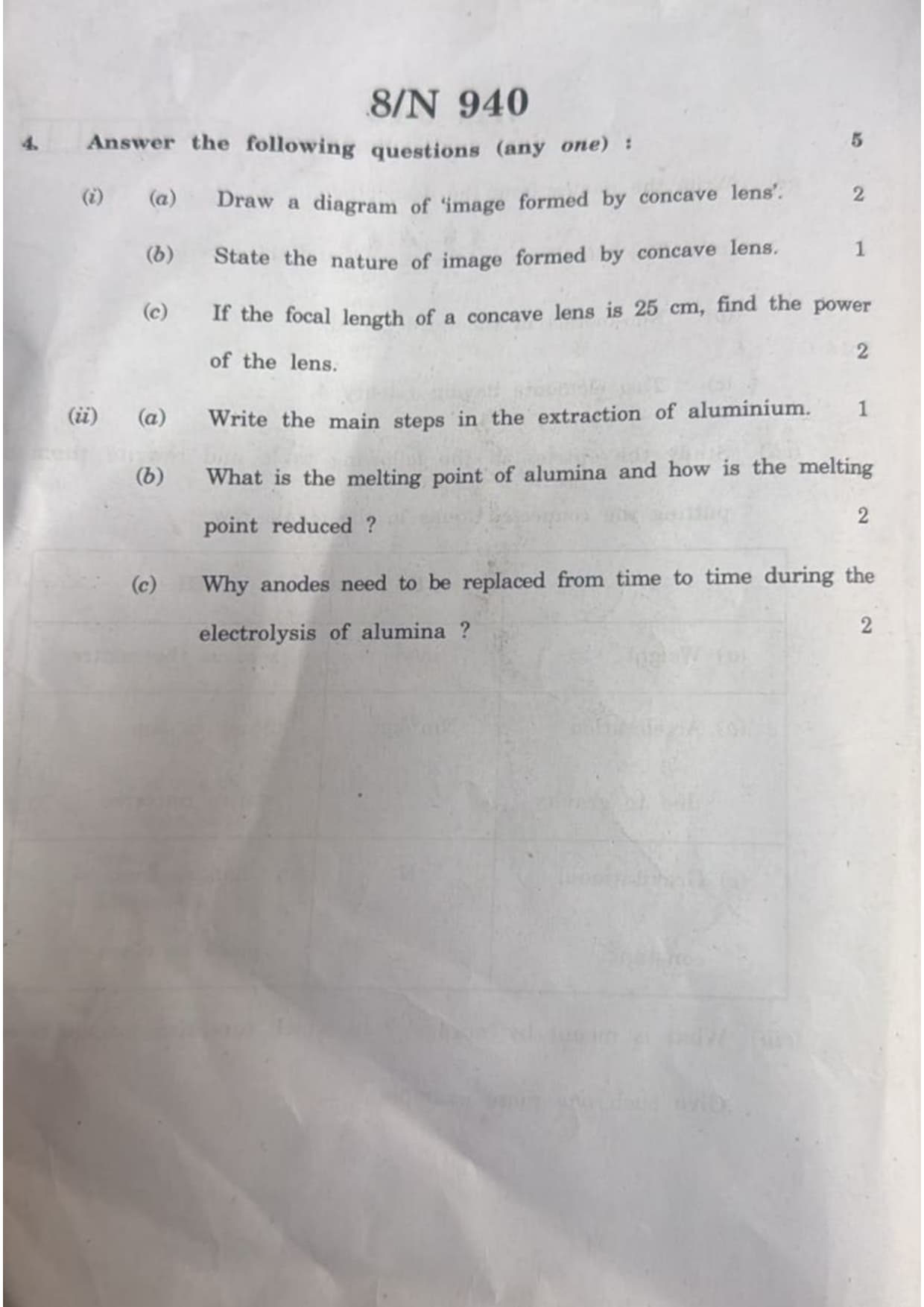
Draw a diagram of 'image formed by concave lens'.
View Solution
A concave lens is a diverging lens. It is thinner at the center and thicker at the edges. When parallel rays of light pass through a concave lens, they diverge after passing through the lens. These diverging rays appear to come from a point behind the lens. This point is where the virtual image is formed.
Step 1: Diagram of the image formed by a concave lens.
In the diagram below, parallel rays of light (\( AB \)) are incident on the concave lens (\( L \)). After passing through the lens, these rays diverge. The diverging rays seem to originate from a point \( I \) behind the lens, which forms the virtual image. This image is upright, diminished in size, and located on the same side as the object.
% The code below assumes you have an image of the diagram. You can replace the image path with your actual image path.
Step 2: Description of image characteristics.
- Virtual: The image cannot be captured on a screen because the light rays do not actually converge; they only appear to converge at a point behind the lens.
- Erect: The image has the same orientation as the object.
- Diminished: The image is smaller than the object.
- On the same side as the object: The image is formed on the same side of the lens as the object, making it a virtual image. Quick Tip: Remember: A concave lens always forms a virtual, erect, and diminished image. The image is formed on the same side of the lens as the object.
State the nature of image formed by concave lens.
View Solution
A concave lens is a diverging lens, and the image formed by it has the following characteristics:
Step 1: Virtual Image.
The image formed by a concave lens is always virtual. This means that the light rays do not actually meet after passing through the lens, but only appear to diverge from a point behind the lens. A virtual image cannot be projected onto a screen.
Step 2: Erect Image.
The image formed by a concave lens is upright (erect). This means that the image maintains the same orientation as the object. The rays of light appear to diverge in such a way that the image is oriented the same as the object.
Step 3: Diminished Image.
The image formed by a concave lens is always smaller than the object. This is because the lens causes the parallel rays of light to diverge, reducing the size of the image compared to the object. Therefore, the image is diminished.
Step 4: Located on the Same Side as the Object.
The image formed is located on the same side of the lens as the object. This is because the diverging rays appear to originate from a point behind the lens, so the image is formed on the same side as the object.
Step 5: Image Formation for Different Object Positions.
No matter where the object is placed (whether near or far from the lens), a concave lens will always form a virtual, erect, and diminished image on the same side as the object. Quick Tip: Remember: A concave lens always forms a virtual, erect, and diminished image. The image is always located on the same side as the object.
If the focal length of a concave lens is 25 cm, find the power of the lens.
View Solution
The power \( P \) of a lens is related to its focal length \( f \) by the formula: \[ P = \frac{1}{f} \]
Where:
- \( P \) is the power of the lens in diopters (D),
- \( f \) is the focal length of the lens in meters.
Given that the focal length of the concave lens is 25 cm, we first convert it to meters: \[ f = 25 \, cm = 0.25 \, m \]
Now, applying the formula for power: \[ P = \frac{1}{0.25} = -4 \, D \]
The negative sign indicates that it is a concave lens.
Thus, the power of the concave lens is -4 diopters (D).
Quick Tip: Remember: For concave lenses, the focal length is negative, and therefore the power is also negative.
Write the main steps in the extraction of aluminium.
View Solution
The extraction of aluminum involves the following main steps:
Step 1: Crushing and Grinding.
The bauxite ore, which is the primary source of aluminum, is crushed and ground into a fine powder to facilitate extraction.
Step 2: Bayer Process.
The crushed bauxite is then treated with sodium hydroxide (NaOH) at high temperatures. This process separates alumina (Al2O3) from impurities like iron oxide and silica. The alumina is then purified by precipitation.
Step 3: Electrolysis (Hall-Héroult Process).
The purified alumina is then subjected to electrolysis, where it is dissolved in molten cryolite (Na3AlF6) and then subjected to direct current. This breaks down the alumina into aluminum metal (Al) and oxygen gas (O2).
Step 4: Collection of Aluminum.
Aluminum metal is collected at the cathode, while oxygen gas is released at the anode. Quick Tip: Remember: The extraction of aluminum involves crushing the ore, the Bayer process for purification, and electrolysis to extract the metal.
What is the melting point of alumina and how is the melting point reduced?
View Solution
Step 1: Melting Point of Alumina.
The melting point of alumina (Al2O3) is very high, around 2072°C. This high melting point makes it difficult to directly use alumina in the electrolysis process.
Step 2: Reduction of Melting Point.
To reduce the melting point, alumina is dissolved in molten cryolite (Na3AlF6), which lowers the overall melting point of the mixture to about 950°C. This allows the electrolysis process to occur at much lower temperatures, making it more energy-efficient. Quick Tip: Remember: The high melting point of alumina is reduced by dissolving it in molten cryolite, which lowers the temperature required for electrolysis.
Write the main steps in the extraction of aluminium.
View Solution
The extraction of aluminum involves the following main steps:
Step 1: Crushing and Grinding.
The bauxite ore, which is the primary source of aluminum, is crushed and ground into a fine powder to facilitate extraction.
Step 2: Bayer Process.
The crushed bauxite is then treated with sodium hydroxide (NaOH) at high temperatures. This process separates alumina (Al2O3) from impurities like iron oxide and silica. The alumina is then purified by precipitation.
Step 3: Electrolysis (Hall-Héroult Process).
The purified alumina is then subjected to electrolysis, where it is dissolved in molten cryolite (Na3AlF6) and then subjected to direct current. This breaks down the alumina into aluminum metal (Al) and oxygen gas (O2).
Step 4: Collection of Aluminum.
Aluminum metal is collected at the cathode, while oxygen gas is released at the anode. Quick Tip: Remember: The extraction of aluminum involves crushing the ore, the Bayer process for purification, and electrolysis to extract the metal.
What is the melting point of alumina and how is the melting point reduced?
View Solution
Step 1: Melting Point of Alumina.
The melting point of alumina (Al2O3) is very high, around 2072°C. This high melting point makes it difficult to directly use alumina in the electrolysis process.
Step 2: Reduction of Melting Point.
To reduce the melting point, alumina is dissolved in molten cryolite (Na3AlF6), which lowers the overall melting point of the mixture to about 950°C. This allows the electrolysis process to occur at much lower temperatures, making it more energy-efficient. Quick Tip: Remember: The high melting point of alumina is reduced by dissolving it in molten cryolite, which lowers the temperature required for electrolysis.
Why do anodes need to be replaced from time to time during the electrolysis of alumina?
View Solution
During the electrolysis of alumina (Al\(_2\)O\(_3\)), aluminum metal is produced at the cathode, and oxygen gas is released at the anode. The anodes are typically made of carbon (graphite), and over time, the oxygen produced at the anode reacts with the carbon. This reaction forms carbon dioxide gas (CO\(_2\)), which causes the anode to gradually burn away and get consumed.
The reaction at the anode is: \[ 2 \, O^{2-} \rightarrow O_2(g) + 4e^- \]
The oxygen gas formed reacts with the carbon anode: \[ C + O_2(g) \rightarrow CO_2(g) \]
As the carbon is consumed, the anodes need to be replaced periodically to ensure the continuous operation of the electrolysis process. Without regular replacement, the anodes would wear out and eventually break down.
Thus, the anodes need to be replaced from time to time during the electrolysis of alumina due to the consumption of carbon in the reaction with oxygen.
Quick Tip: Remember: The consumption of carbon anodes is due to the reaction of oxygen with the carbon, forming carbon dioxide, which gradually reduces the anode's size.



Comments