




BITSAT 2026 Question Paper for April 19 Shift 2 is available here. BITS Pilan conducted BITSAT Session 1 absentee slot exam on April 19, 2026 in Shift 2 from 2 PM to 5 PM. BITSAT exam is held in a CBT Mode at various exam centres in India and abroad for students to apply for Integrated programs at BITS Campuses in Pilani, Goa and Hyderabad.
- BITSAT question paper contains 130 questions divided into 5 sections- Physics and Chemistry with 30 questions each, English Proficiency with 10 questions, Logical Reasoning with 20 questions and Mathematics or Biology with 40 questions.
- Each correct answer gets you 3 marks while incorrect answer has an negative marking of 1.
Candidates can download The BITSAT 2026 April 19 Shift 2 Question Paper with answer key and solution PDF from the links provided below.
BITSAT 2026 April 19 Shift 2 Question Paper with Solution PDF (Memory-Based)
| BITSAT 2026 Question Paper April 19 Shift 2 | Download PDF | Check Solutions |
Also Check:



Young's moduli of the material of wires A and B are in the ratio of 1:4, while its area of cross sections are in the ratio of 1:3. If the same amount of load is applied to both the wires, the amount of elongation produced in the wires A and B will be in the ratio of (Assume length of wires A and B are same)
A hollow glass stopper of relative density 2.5 just sinks in water. The ratio of volume of cavity to that of stopper is
A gas undergoes a process in which the pressure and volume are related by \( VP^n = constant \). The bulk modulus of the gas is
The initial pressure and volume of an ideal gas are \( P_0 \) and \( V_0 \). The final pressure of the gas when the gas is suddenly compressed to volume \( V_0/4 \) will be: (Given \( \gamma \) = ratio of specific heats at constant pressure and at constant volume)
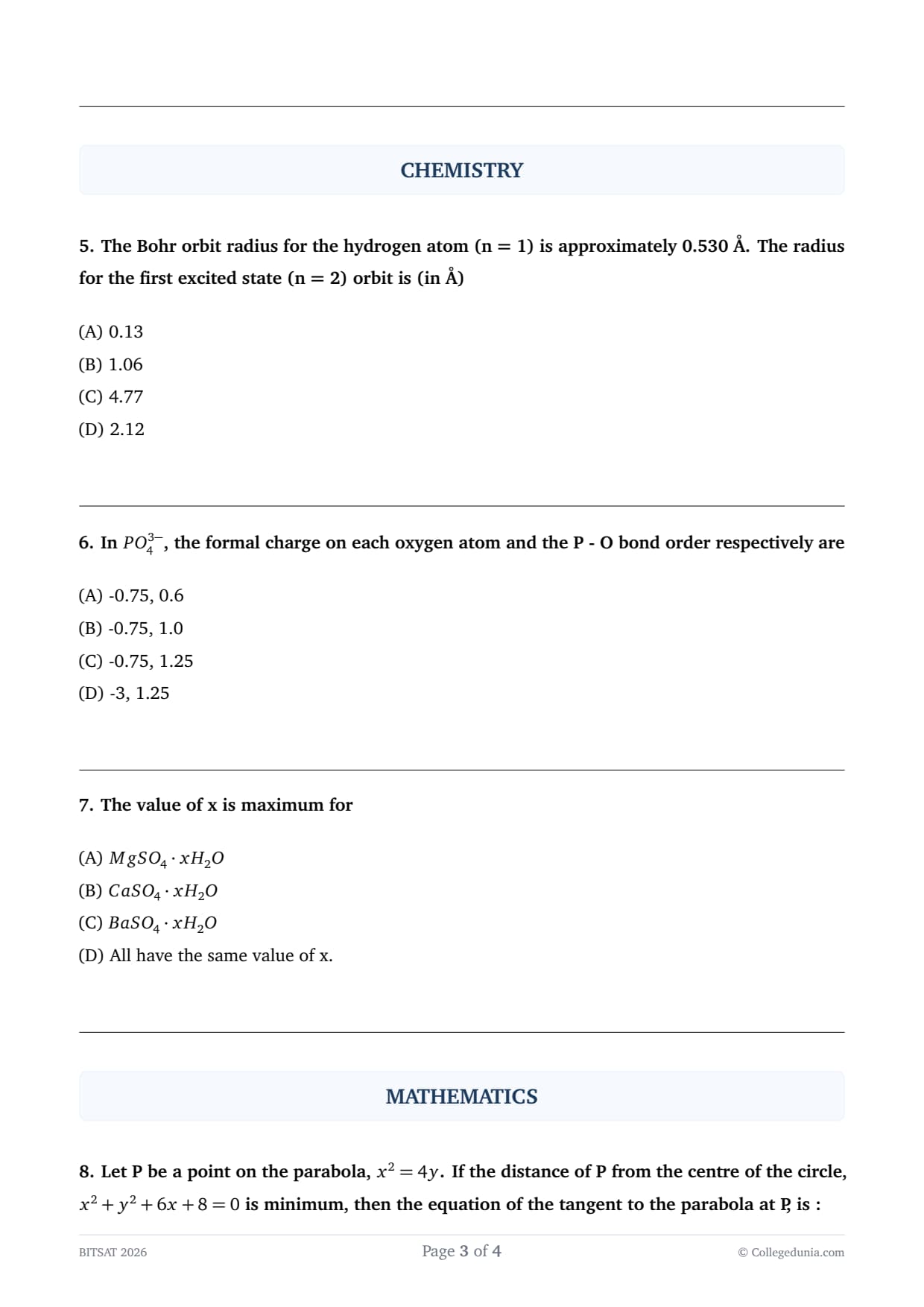
The Bohr orbit radius for the hydrogen atom (n = 1) is approximately 0.530 Å. The radius for the first excited state (n = 2) orbit is (in Å)
In \( PO_4^{3-} \), the formal charge on each oxygen atom and the P - O bond order respectively are
The value of x is maximum for
Let P be a point on the parabola, \( x^2 = 4y \). If the distance of P from the centre of the circle, \( x^2 + y^2 + 6x + 8 = 0 \) is minimum, then the equation of the tangent to the parabola at P, is :
If \( x = \sqrt{2^{cosec^{-1} t}} \) and \( y = \sqrt{2^{sec^{-1} t}} (|t| \ge 1) \), then dy/dx is equal to :
If \( f(x) = \int_0^x t(\sin x - \sin t)dt \) then :
BITSAT 2026 Chapter-Wise Weightage
The BITSAT syllabus includes NCERT Class 11 and 12 topics, but some chapters tend to hold more significance due to their conceptual knowledge.
Physics
| Chapter | Expected Weightage (%) |
|---|---|
| Laws of Motion | 8–10% |
| Current Electricity | 7–9% |
| Ray Optics & Wave Optics | 6–8% |
| Thermodynamics | 6–7% |
| Electrostatics | 5–7% |
Chemistry
| Chapter | Expected Weightage (%) |
|---|---|
| Chemical Bonding | 8–10% |
| Organic Chemistry (Basics + Reactions) | 10–12% |
| Coordination Compounds | 6–8% |
| Electrochemistry | 5–7% |
| p-Block Elements | 6–8% |
Mathematics
| Chapter | Expected Weightage (%) |
|---|---|
| Calculus (Limits, Integration, Differentiation) | 12–15% |
| Vectors & 3D Geometry | 8–10% |
| Complex Numbers & Quadratic Equations | 6–8% |
| Probability | 6–8% |
| Coordinate Geometry | 7–9% |



Comments